Some links on this page are affiliate links — marked with aff — and if you buy through them I may earn a small commission at no extra cost to you. Read the full disclosure.
The sub-$300 resin printer market in 2026 is not the compromise tier it used to be. Three years ago, spending under $300 meant accepting meaningful quality trade-offs. Today it means choosing between genuinely capable machines at three different price points, each suited to a different printing pattern.
The cheapest sensible printer, the Elegoo Mars 4aff at $149, runs 18 micron pixels in a small tidy machine. The best mid-format value, the Elegoo Saturn 3aff at $230, puts those same excellent print dimensions onto a build plate large enough to batch infantry. The speed-tier pick, the Elegoo Mars 5 Ultraaff at $249, adds a tilting VAT without crossing the $300 line. None of these are compromise machines. That is the article.
The shape of the sub-$300 segment in 2026
Three full classes sit comfortably under $300:
Small-format Mars class. The Mars 4 ($149), Mars 4 Ultraaff ($170), and Mars 5 Ultra ($249) all use the 153 by 77 mm build plate. The Mars 4 is the entry floor. The Mars 4 Ultra adds tempered glass screen protection, Wi-Fi, and anti aliasing support via the .cbt file format. The Mars 5 Ultra adds the tilting VAT and auto levelling, which changes the daily printing experience considerably.
Mid-format Saturn class. The Saturn 3 ($230) is the one to know here. A 219 by 123 mm build plate, 24 micron pixels, and a feature set that prioritises doing the basics correctly over adding smart features that do not improve print quality.
What else exists. The Anycubic Photon Mono 4 line sits in this segment too. The brief for this article focuses on Elegoo because the value density is higher and the machines are better documented. If you are committed to Anycubic, the Photon Mono M5 is the Saturn-class equivalent, though it is now behind the Saturn 3 on value.
The price floor for a competent miniature printer has dropped significantly since 2023. The Mars 4 at $149 prints miniatures with the same pixel resolution as machines that cost twice as much at the time of its release. That is not marketing copy. That is the current state of the market.
Pick 1: Elegoo Mars 4 ($149) for the absolute floor
The Mars 4 is genuinely one of the best budget picks in resin printing. You are paying for no smart features and no speed tricks, just 18 micron pixels in a small tidy machine. Pixel size is not going to meaningfully improve below this for miniature work without diminishing returns you would need a magnifier to spot, which makes this effectively a future-proof entry into the hobby.
The build plate is 153 by 77 by 175 mm. For single-figure printing that is ample. For batching infantry it is workable but not generous. For a painter who prints one or two figures at a time, the plate size is rarely the constraint.
The beginner printer framing holds because the Mars 4 does not demand anything from you. No Wi-Fi to configure, no auto levelling calibration loop to learn, no tilting mechanism to watch for long-term wear. Wash your builds in IPA, cure under UV, and print the next batch. The machine runs nFEP release film and has a built-in air filter. Both matter: nFEP is easy to replace when it degrades, and the air filter makes apartment printing less aggressive without requiring a separate enclosure.
With the Mars 5 series now shipping, the price on the Mars 4 has stabilised low. The value argument only gets stronger.
For more on how the Mars 4 compares to its direct successor, see the Elegoo Mars 4 vs Mars 4 Ultra comparison.
Pick 2: Elegoo Saturn 3 ($230) for mid-format value
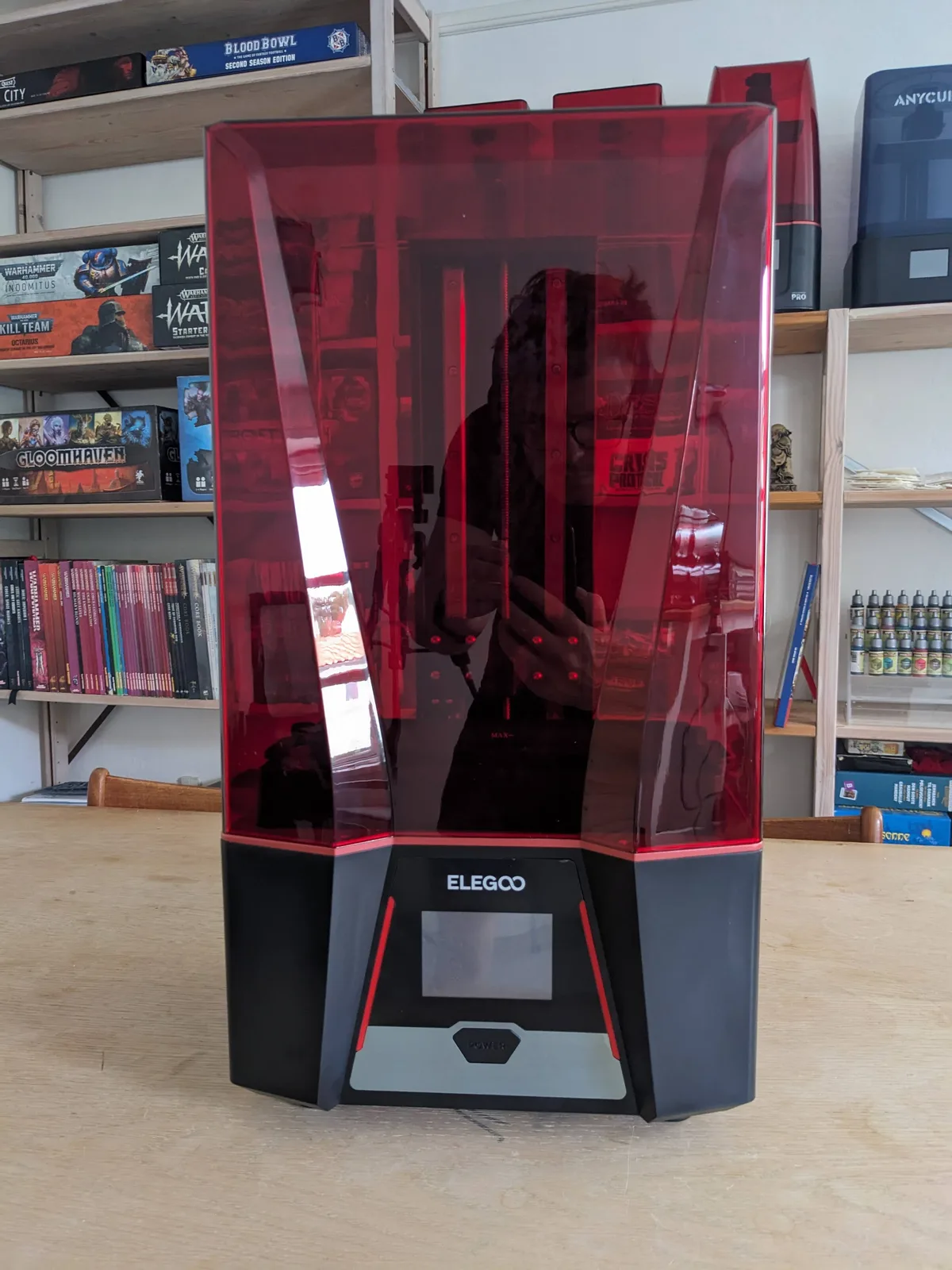
The Saturn 3 is the printer you buy when you need a bigger plate and do not want to pay for features you will not use. The build plate is 219 by 123 by 250 mm. That is large enough to print six to eight 32 mm infantry pre-supported per session, or to handle terrain pieces and larger model kits that will not fit on a Mars-class plate.
The pixel pitch is 24 microns rather than 18. On finished miniatures at normal viewing distances, the difference is not obvious. On ultra-fine detail printed at 28 mm scale and painted close-up, a trained eye can tell. For the majority of tabletop use, 24 micron pixels are more than adequate.
What makes the Saturn 3 a recommendation rather than just a capable machine is the attitude behind it. No smart features, no speed gimmicks, just a 24 micron pixel screen on a big build plate at a very fair price. The fans shut down when the printer is idle, which alone puts it ahead of some newer machines in the same price range. That is not a small point. A fan that runs continuously between prints is a minor annoyance that compounds over time.
The Saturn 3 has a built-in air filter and tempered glass over the LCD. Both are useful. For the price, this is hard to argue with.
The Saturn 4 exists at $279, just $49 more. It is not a better machine. It is an awkward middle position in the lineup with no tilting VAT, no anti aliasing support, and smart features that do not improve print quality. Either save the $49 and get the Saturn 3, or spend $99 more over the Saturn 3 and get the Saturn 4 Ultra. The Saturn 4 is the one to skip.
See the full Elegoo Saturn 3 vs Saturn 4 Ultra comparison for the full-detail breakdown of what the extra money actually buys.
Pick 3: Elegoo Mars 5 Ultra ($249) for speed-tier headroom
The Mars 5 Ultra is the most expensive choice in the sub-$300 segment at $249. It is also the most capable machine under the cap if your printing pattern benefits from shorter sessions.
Elegoo solved the speed problem by tilting the VAT. When a resin printer finishes a layer, the build plate must lift the cured layer off the film at the bottom of the VAT. On a straight peel machine like the Mars 4 and Saturn 3, that force is the limiting factor for thin features and print speed. A tilting VAT changes the geometry. Instead of pulling the whole layer straight up, the VAT tilts sideways and the release happens progressively from one edge. Peel force drops significantly. Fine features on miniatures are less likely to tear on the lift, and the lift cycle is shorter, so overall print speed increases.
The Mars 5 Ultra keeps the 18 micron pixel resolution and does not ask you to use speciality resin to get the speed benefit. That is the distinction that matters. Other approaches to speed in this price bracket involve compromises that degrade print quality. The tilting VAT approach does not.
At $249 it sits $100 above the Mars 4. What you gain is the tilting VAT, auto levelling, RERF support, and tempered glass screen protection. What you give up compared to the Mars 4 Ultra is the built-in air filter. The Mars 5 Ultra does not have one. If apartment printing is your situation, that is worth noting before you buy.
For a direct comparison of the two most capable small-format machines in this segment, see Mars 4 Ultra vs Mars 5 Ultra: Which to Buy.
What you cannot get under $300
Understanding the cap means understanding what sits just above it.
The Saturn 4 Ultraaff at $329 is $30 over the line. For that $30 over the cap you gain the tilting VAT on a mid-format plate, anti aliasing support, and a machine with meaningfully more daily throughput than the Saturn 3. If your printing pattern is heavy on batched infantry, the Saturn 4 Ultra is the machine to aim at once you are willing to cross the $300 threshold.
The Saturn 4 Ultra 16Kaff sits at $420. That is $120 over the cap and a different class entirely, with 16K resolution and a heated VAT approach. Worth knowing it exists, but not the conversation for a sub-$300 brief.
The frame is useful: an extra $30 over the Saturn 3’s $270 price point unlocks the tilt-VAT mid-format machine. An extra $190 over the Mars 5 Ultra unlocks the heated-VAT class. Both of those are real upgrades. The machines under $300 are not making meaningful sacrifices to stay there; the machines above $300 are genuinely adding capability.
The answer for each reader pattern
Two sentences each, based on how you actually print.
Tightest budget, small models only. The Mars 4 at $149. Nothing else at this price gives you 18 micron pixels, and nothing else you need.
Mid budget, plans to batch infantry. The Saturn 3 at $230. The big plate is the feature you are actually paying for, and the Saturn 3 delivers it with no compromises that cost you print quality.
Mid budget, values speed over plate size. The Mars 5 Ultra at $249. The tilting VAT changes the printing pattern in ways that become obvious in the first week. If session length matters to you, spend the extra $100 over the Mars 4.
Wargamer who prints lots of terrain. Saturn 3 every time. Terrain benefits from the larger plate more than it benefits from tighter pixel resolution, and the Saturn 3 handles terrain builds on a budget better than anything else in this segment.
Beginner who is not sure. Mars 4 first, then Saturn 3 as a second machine when the plate becomes the constraint. Starting with the Mars 4 teaches you the workflow without committing $230 to a machine you might use wrong for the first three months. The Saturn 3 is an easy second buy when you know what you are doing.
What to avoid in the segment
Elegoo Mars 5 ($169). The name implies an upgrade over the Mars 4. The specs do not support that. The Mars 5 runs a 35 micron pixel screen, which is worse than the 18 microns on the Mars 4. It sits in the same price band as the Mars 4 Ultra at $170. The naming is confusing and the machine is a step backwards on pixel quality. There is no reason to pick the Mars 5 over the Mars 4.
Elegoo Saturn 4 ($279). At $279, the Saturn 4 sits $49 above the Saturn 3. For that premium you get smart features and auto levelling, but no tilting VAT and no anti aliasing support. Smart features do not make miniatures print better. An awkward middle position in the lineup with nothing that justifies the premium over the Saturn 3. Skip it.
Closing
The sub-$300 segment covers more printing patterns in 2026 than it ever has. The Mars 4 earns its price. The Saturn 3 earns its price. The Mars 5 Ultra earns its price. The segment between them is mostly confusion from printer naming conventions that do not map neatly to actual quality tiers.
For the full breakdown of the resin printer market beyond the $300 cap, including what the Saturn 4 Ultra and the 16K machines actually offer, see the best 3D printer for miniatures buying guide. If you are still deciding which printer class fits your printing pattern, the how to choose a resin 3D printer guide walks through the decision framework before you commit.