Some links on this page are affiliate links — marked with aff — and if you buy through them I may earn a small commission at no extra cost to you. Read the full disclosure.
D&D printing is the opposite shape from Warhammer printing. Wargamers batch ten infantry weekly, run another ten the week after, and the printer earns its keep through volume. A D&D party needs one wizard, one rogue, one dragon for next month, then nothing for two weeks. The right printer for the D&D table is the one that handles single-figure hero printing well and stretches up to the occasional dragon when the campaign calls for it. It is not the one optimised for batch volume.
That distinction changes the buying decision significantly. This article covers what it means in practice, which printers fit the D&D use case, and where spending more actually earns you something versus where it is just spec sheet numbers you will never notice on a 28 mm figure.
D&D printing is single-figure printing
Most D&D miniatures are individual characters: party members, boss monsters, key NPCs, the occasional dramatic set piece. A typical campaign might produce a handful of figures per session arc. Players often commission a single model for their character and print nothing else for months. DMs print monsters episodically, not in squads.
This matters because the main advantage of a Saturn-class printer is a large build plate. At 219 by 123 mm, it holds roughly twelve to sixteen infantry figures per run. That advantage is wasted if the printer runs once a fortnight with one or two figures on the plate. You are paying for plate size you are not using, and spending an extra $60 to $80 over the Mars-class equivalent to get it.
The Mars-class plate at 153 by 77 mm is ample for a single hero figure, a mounted character, or a small group. It is the natural format for D&D printing.
Pick 1: Elegoo Mars 4 Ultra ($170) for most D&D printers
The Mars 4 Ultraaff is the default answer for D&D. It runs 18 micron pixels on the same small Mars plate as every other Mars-class machine. What makes it the right pick over the base Mars 4 is anti aliasing support: the Mars 4 Ultra saves files as .cbt format, which gives you smooth curved surfaces on cloaks, armour panels, and faces. That matters more for a character figure the player keeps for years than it does for a rank-and-file infantry model.
The tempered glass screen cover is the other real difference over the plain Mars 4. It protects the LCD from resin spills during normal use, which extends the working life of the most expensive component to replace. For a printer that sits on a desk and prints occasional hero models, that is a meaningful durability benefit.
At $170 the Mars 4 Ultra is not a compromise machine. It prints detailed character work at a quality level that exceeds anything you can buy ready-painted at this price, and the only thing it gives up against more expensive options is print speed.
Pick 2: Elegoo Mars 5 Ultra ($249) for the DM who preps the night before
The Mars 5 Ultraaff runs the same 18 micron pixels as the Mars 4 Ultra on the same build plate. The meaningful difference is the tilting VAT. Elegoo solved the speed problem by tilting the VAT rather than compromising pixel size or layer quality. The result is a printer that gets through a hero model in roughly half the time compared to a straight-peel machine.
For most D&D players, print speed is a nice-to-have. You set the print running, leave it overnight, and come back to a finished model. The Mars 4 Ultra handles this comfortably. But for a DM who realised on Thursday night that the campaign needs a specific monster for Saturday, the speed difference between the two machines is the difference between printing tonight and printing tomorrow with no margin left for a support failure.
The Mars 5 Ultra also adds auto levelling, which removes one source of failed prints for newer operators. The build plate pools more liquid resin during cleanup than the Mars 4 Ultra, which is a minor annoyance worth knowing about. The air filter present on the Mars 4 Ultra is absent on the Mars 5 Ultra, so factor in ventilation if that matters to your setup.
The $79 gap between the two machines is reasonable if speed genuinely matters to your printing pattern. If it does not, the Mars 4 Ultra remains the better value.
The dragon question
Every D&D campaign eventually needs a dragon. An ancient dragon at 28 mm scale on a 75 to 100 mm base is a substantial model, and this is the one moment where the Mars plate size becomes a real constraint.
Most ancient dragon files at standard D&D scale fit on a Mars plate with the wings folded or posed close to the body. File creators who release files for home printing are aware of Mars-class build volumes and design accordingly. A 75 mm base model with folded wings typically fits the 153 by 77 mm plate, sometimes at a diagonal. A 100 mm base model with a full wingspan may not, and the slicer will tell you before you start.
The practical approach is to slice large dragons into halves or sections: body and head as one print, wings as a second, tail as a third. This is standard practice in the hobby and adds one assembly step with a spot of glue rather than any meaningful difficulty. Most dragon files come pre-sectioned for exactly this reason.
A Saturn-class printer removes the slicing step and lets you print a large dragon in one run. If the campaign features regular giant creatures, a monthly dragon, a lich on a huge base, the Saturn 3 at $230 is a reasonable upgrade. For a party that encounters one large creature per campaign arc, the Mars handles it without complaint.
The DM terrain question
D&D terrain is fundamentally one-off. A specific tavern interior, a dungeon entrance with the right archway design, the boss room floor plan: each of these prints once and sits on the table for one session. This is meaningfully different from Warhammer terrain, which prints in batches because the game needs matched pairs of objectives and cover across the whole board.
Because D&D terrain prints once, resin is an acceptable choice for it. The detail level is high and the one-off nature does not trigger the cost argument against resin for bulk terrain. A Mars-class printer handles room tile sections without difficulty. Saturn-class plates allow larger single-piece floor sections.
That said, if terrain is a major focus for the campaign, an FDM printer handles bulk terrain faster and at lower material cost per print. The best 3D printer for terrain article covers FDM picks for that use case. The short answer is that resin for hero figures plus FDM for terrain scenery is a reasonable two-printer setup if the campaign demands both.
Pre-supported files matter more for D&D than for any other use case
A Warhammer player can absorb a failed support on one Marine because nine others came off the plate cleanly. A D&D player who prints the party’s rogue for three hours and pulls off a figure with a broken hand has no spare. There is one rogue.
Pre-supported files from reputable creators are therefore more important for D&D than for batch miniature printing. Creators on platforms like MyMiniFactory and Patreon who specifically target the D&D market have generally put serious work into their supports because they know the customer is printing singles, not squads. Hero Forge’s printable files come pre-supported for exactly this reason.
Slicer skill matters too. Understanding how to add and adjust supports reduces failed prints significantly. The Chitubox vs Lychee vs manufacturer slicers article covers the options in detail. The short version: Lychee Slicer’s auto support engine is the most reliable starting point for character models with capes, weapons, and outstretched limbs.
Resin choice for D&D
Most standard grey resins print D&D miniatures adequately. The detail tier of standard resin is enough for a figure that will sit across the table at arm’s length. Where resin choice starts to matter is for a character model the player intends to paint carefully and keep long term.
Detail-class resins print finer textures, crisper facial features, and cleaner fabric folds than standard grey. The difference is visible under painting, where thin washes pool in recesses and drybrushing catches surface texture. For a hero figure that will receive hours of painting attention, the better resin earns its keep.
The best resin for miniatures article covers the specific options. The relevant note for D&D is that detail resin is worth the cost on character figures but not on terrain scatter or single-use set dressing.
The painter who collects rather than plays
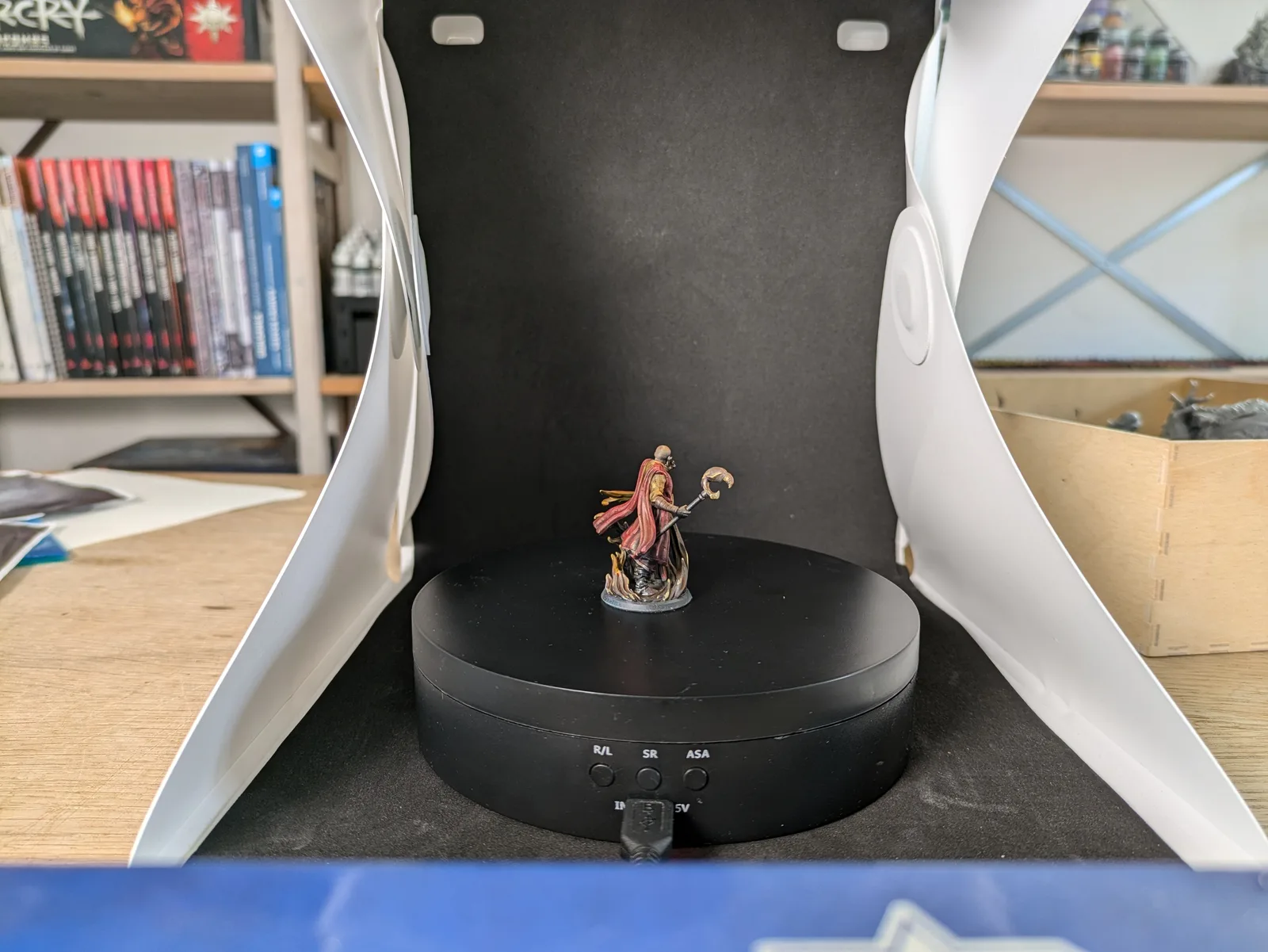
A significant portion of D&D printers are painters first and players second. The figure exists to be painted, photographed, and added to a display collection. The tabletop session is secondary or hypothetical. This group is printing at the pace of a collector: one figure per week or fortnight, chosen for personal interest, finished carefully before the next one starts.
The collection mindset rewards exactly the same Mars 4 Ultra pick as the active player. Single figures, maximum detail, no batch pressure. The Mars 4 Ultra’s anti aliasing support and 18 micron pixels produce character work that holds up at collector standards. The lack of speed is irrelevant when the print runs overnight and the model sits on the desk for a week while it is painted.
The one difference for collectors is that monster scale may never come up at all. A collector printing individual 28 mm heroes has no campaign driving a dragon print. The Mars plate size is never a constraint.
What to avoid for D&D
The Phrozen Sonic Mighty 16K at $720 is overkill for most D&D printing. Its 14 micron pixels are genuinely best in class and the mechanical build is serious hardware, but the pixel advantage over an 18 micron machine is not perceptible on a 28 mm figure at normal viewing distance. The calibration investment is also substantial: non-square pixels mean existing community exposure profiles do not transfer and every resin requires fresh calibration. That overhead is justified for someone already deep in the hobby who wants the ceiling. It is not justified for printing party members.
The Elegoo Saturn 4 Ultra 16Kaff at $420 is the right answer if the campaign genuinely features monsters every session, the DM needs large creatures on short notice, and batch printing of dungeon tiles is a real workflow. At that point the heated VAT, 19 micron pixels, and large plate make sense. For everyone else it is $250 more than the Mars 4 Ultra for plate size that a D&D printing pattern rarely uses.
The Elegoo Saturn 3aff at $230 is the reasonable middle option for DMs who find themselves wanting the bigger plate but cannot justify the Saturn 4 Ultra 16K’s price. Cheap, capable, does the basics correctly. If the campaign has regular monsters and the DM prints terrain, the Saturn 3 is the upgrade that makes sense.
The verdict
Mars 4 Ultra ($170) for most D&D printers. Single-figure hero work, anti aliasing for character detail, durable tempered glass screen, sensible price. The default answer.
Mars 5 Ultra ($249) if print speed matters. DMs who prep the night before, players who want a finished figure quickly. The $79 premium buys real time savings for the impatient printer.
Saturn 3 ($230) for the DM with a regular monster habit. More plate, more flexibility for large creatures and terrain sections, fair price. Not the default but the right call for specific DM workflows.
Everything above those three is solving problems that D&D printing does not actually have. Start with the Mars 4 Ultra and upgrade when the plate size or the print speed becomes a genuine constraint on your table.
For a broader view of the resin market including printers suited to other miniature use cases, the best 3D printer for miniatures guide covers the full range. The Mars 4 Ultra vs Mars 5 Ultra comparison article goes deeper on the specific choice between the two main D&D picks if you want to work through that decision in detail.