Some links on this page are affiliate links — marked with aff — and if you buy through them I may earn a small commission at no extra cost to you. Read the full disclosure.
Warhammer printing is a different problem from “best resin printer for miniatures” because the unit of print is a squad, not a model. A painter printing a single hero can get away with almost any current Mars or Saturn class machine. A Warhammer player filling out a 2 000 point army runs the printer three or four nights a week, every week, until the codex changes and they start again. That repetition changes what matters in a machine.
The buying guide at the resin printer buying guide covers the full landscape. This article is narrower: which resin printer survives the Warhammer printing volume, handles heroic 32 mm scale well, and pays back its cost across an army rather than a display cabinet.
Why Warhammer printing is different
The scale question is often raised by new players and it is almost always the wrong question to start with. Current Games Workshop infantry uses heroic 32 mm scale. That means a Space Marine stands roughly 40 mm from boot to eye. That is comfortably within the sweet spot of every Mars and Saturn class printer made since 2023.
Pixel size does matter at this scale, but the effect is subtle. An 18 micron pixel printer will render power armour panel lines and Custodes filigree more crisply than a 24 micron machine, but the difference is visible at arm’s length only on the sharpest details. It is not the gap between “good” and “bad”. Both classes of printer produce results that look excellent on a painted army.
What matters much more is build volume. A Warhammer army involves dozens of rank and file infantry, vehicles, and characters. The painter who finishes an army in six months is running the printer often. A Mars class plate holds roughly 6 to 8 infantry per session. A Saturn class plate holds roughly 12 to 16. Over an army that difference collapses into months.
Pixel size decides how good each individual miniature looks. Build plate size decides how fast you fill a cabinet. For Warhammer, build plate size is the argument that pays back.
The right pick depends on the army
Not every Warhammer painter is doing the same job. Three broad patterns emerge:
Infantry-heavy armies (Astra Militarum, Tyranids, Orks, Chaos Cultists): these players are running the printer constantly. Batch volume is everything. The Saturn 3aff at $230 or the Saturn 4 Ultraaff at $329 are the natural picks here. A full squad per session instead of half a squad is a real difference across 3 000 points.
Character-focused or elite armies (Space Marines, Custodes, named characters): fewer models, more detail per model. A Mars class printer at 18 microns earns its keep here. The Mars 4 Ultraaff at $170 or the Mars 5 Ultraaff at $249 cover this pattern well. One hero per print at 18 microns with anti aliasing switched on is a noticeably better outcome than the same figure at 24 microns.
Full army builders (rank and file, characters, vehicles, terrain scatter): the answer is two printers. A Saturn 3 for infantry batches and a Mars 4 Ultra for character work is the most efficient pairing under $400 total. Both machines run simultaneously, one on rank infantry and one on the week’s hero or centrepiece model.
Pixel size and what Warhammer actually needs
The current range for serious miniature work runs from 18 microns at the Mars end to 24 microns at the Saturn end. Both print heroic 32 mm infantry well. Neither will embarrass a painter who takes the time to set up supports correctly.
Below 18 microns, the Phrozen Sonic Mighty 16K prints at 14 by 19 microns on a Saturn sized plate. At $720, it is technically the best in class for visible detail. The print quality is genuinely outstanding. The issue for Warhammer is that the improvement over 18 microns is very hard to see at tabletop scale without magnification, and the $500 gap over a Saturn 3 buys a lot of resin instead. The Mighty 16K is the right pick for a display painter or a detailed character sculptor. For an infantry painter running batch prints four nights a week, it is overkill.
Above 35 microns, the pixel size starts to show on fine armour details and facial structure. Anything in that bracket was either a budget pick or an older generation. It is not a band to chase for Warhammer work.
Build volume maths for batch printing
The maths here is simple and worth stating plainly.
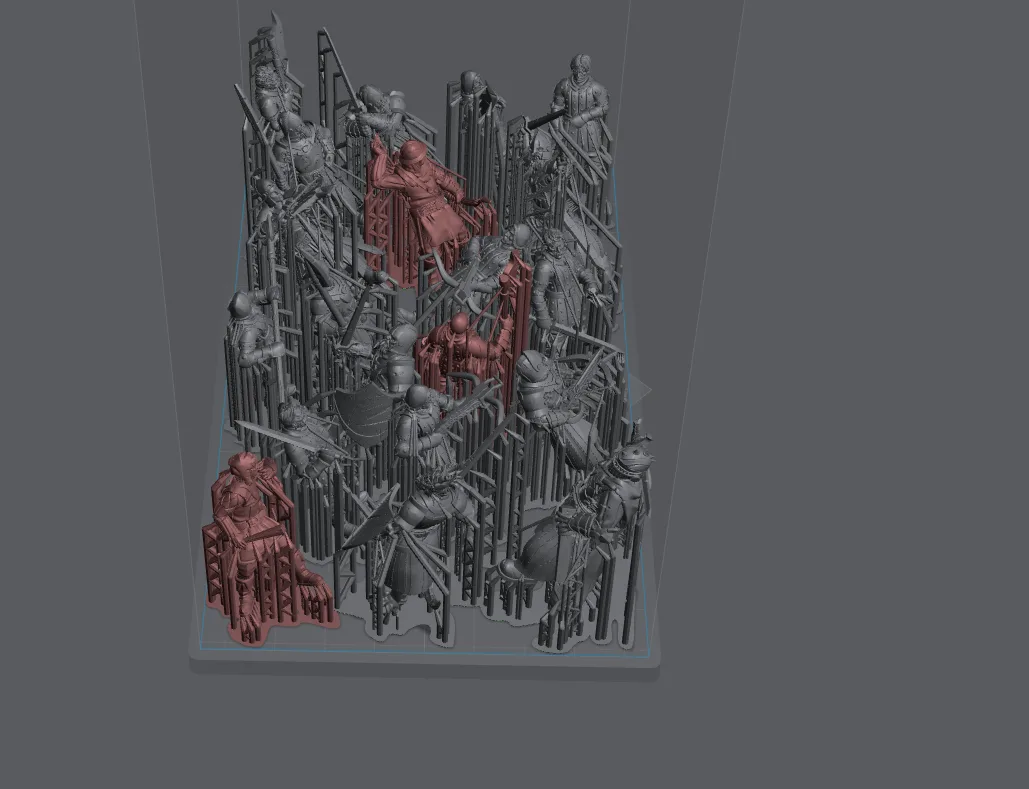
A Mars class build plate is 153 by 77 mm. At heroic 32 mm scale with standard round bases and a reasonable layout, roughly 6 to 8 infantry fit per print. If each print runs three to four hours, a single Mars printer produces roughly two batches per evening.
A Saturn class build plate is 219 by 123 mm. The same infantry at the same scale fits roughly 12 to 16 per plate. Two batches per evening now means 24 to 32 models. An Astra Militarum player who needs 60 infantry feels that difference within a week.
Vehicles and walkers benefit more from build height than build width. The Saturn 3 has 250 mm of Z travel, which handles most walker and walker-scale vehicle hulls without slicing. Mars class printers at 165 to 175 mm of Z will handle smaller walkers and bikes but will require a hull to be split for anything at Dreadnought scale or above.
The Saturn 3 as the baseline Warhammer pick
The Elegoo Saturn 3 at $230 is the natural answer for most Warhammer players. It does not have the tilting VAT of the Saturn 4 Ultra, no wifi, no auto levelling. What it has is a 24 micron pixel screen on a large build plate, tempered glass screen protection included, and fans that shut down when the printer is idle. The Saturn 3 is a printer that prioritises what matters for print quality and ignores the rest.
For rank infantry printing that is exactly the right trade. The features you are not paying for do not affect print quality. The screen size you are paying for directly affects how many models come off each plate.
The comparison between the Saturn 3 and Saturn 4 Ultra is worth reading in full if the $100 premium is within reach. The detail is covered in the Saturn 3 vs Saturn 4 Ultra comparison. The short version: the Saturn 4 Ultra adds a tilting VAT (faster prints, no quality compromise) and anti aliasing support. If the army involves a lot of character work and fine detail, that anti aliasing matters. For pure rank infantry it is a real but smaller gain.
The contrarian pick: Mars 4 at $149
Not every Warhammer player is printing for an army list. Some painters buy a box of Space Marines, print a few conversions or alternative poses, and paint them over the course of a month. For this volume, the cheapest sensible resin printer in 2026 is the right answer.
The Elegoo Mars 4 at $149 is that printer. Eighteen micron pixels in a compact machine with an air filter included. No smart features, no speed hardware, but genuinely one of the best value picks in consumer resin printing. For a player who runs one squad of Marines per week and nothing more, the Mars 4 pays back its cost faster than any Saturn class machine, and the smaller plate is never a constraint at that volume.
The Mars 4 does not support anti aliasing properly because it is locked to the GOO file format. For rank infantry this is a minor issue. For detailed character work it is worth upgrading to the Mars 4 Ultra at $170, which can export as CTB and handles anti aliasing correctly. The $21 difference is worth it for any painter who cares about the smoothness of curved surfaces.
Terrain considerations
Resin printers are the correct tool for Warhammer miniatures. They are generally not the correct tool for bulk terrain.
Scatter terrain printed in resin is expensive, slow, and fragile compared to FDM terrain. A ruin wall or a set of barricades in resin costs roughly the same in material and time as an equivalent FDM print but with more failure modes, a wash and cure step, and significantly more chemical handling.
For dedicated terrain printing, FDM is the right answer. The full breakdown of terrain-specific printer picks is at the FDM terrain printer guide. A dedicated FDM printer alongside a resin printer for miniatures is the setup most serious Warhammer players eventually land on.
Where resin terrain does make sense is for small, detailed scatter pieces at miniature scale: objective markers, alien flora, detailed bases, dungeon-tile style inserts. At that scale and detail level, resin earns its place.
Second hand is worth serious consideration for Warhammer
Warhammer players print volume. The difference between an 18 micron printer and a 14 micron printer is very small at tabletop scale. The difference between a $720 printer and a $150 second hand printer is $570 of resin and bases.
The Elegoo Saturn 2 second hand is the specific machine to watch. It is out of production, so it does not appear on new-printer lists, but on the second hand market a Saturn 2 at around $80 to $100 prints rank infantry that nobody at the table will tell apart from Saturn 4 Ultra output at 28.5 microns. It ran for years as a serious hobbyist workhorse and the hardware is proven. The full case for second hand buying, including what to check before purchase, is at the second hand resin printer guide.
The Saturn 3 also appears on the second hand market regularly at $150 to $180. At that price it is the best value mid-format Warhammer printer available by a significant margin.
Files: where Warhammer-scale miniatures actually come from
Games Workshop miniatures are GW intellectual property and cannot legally be printed from fan files. What the third party creator ecosystem offers is a large and growing range of miniatures designed to be compatible with the Warhammer table without using GW IP directly.
The creators worth knowing for this use case: Station Forge, Red Makers, Titan Forge, Archvillain Games, and One Page Rules. All of them produce ranges designed for heroic 32 mm scale. Designs are available through MyMiniFactory Tribes subscriptions, Patreon, and individual Cults3D purchases. The files come pre-supported for the most part, which matters significantly for infantry batch printing.
Slicer choice affects how well those supports work. The full comparison of slicer options including the Tribes support generation features is at the Chitubox vs Lychee vs manufacturer slicers comparison.
Resin choice for Warhammer
Resin selection matters more for Warhammer than for single-figure printing because the painter is handling resin several nights a week. The full resin breakdown is at the resin buying guide.
The short version for Warhammer painters: if the army is going to be painted to a display standard, Wargamer Resinaff and AmeraLabs TGM-7aff repay the extra cost in detail retention. If the priority is filling a box with painted rank infantry efficiently, standard grey or grey-green resins at commodity prices are the right call. There is no reason to print competition level resin at $40 a litre on models that will be dipped and based for a casual league.
The verdict
For most Warhammer players printing a full army: Elegoo Saturn 3 at $230. Large plate, fair price, does not waste money on features that do not affect print quality.
For character-focused painters and elite infantry armies: Elegoo Mars 4 Ultra at $170. Eighteen micron pixels, anti aliasing support via CTB export, tempered glass screen protection.
For full army builders who want to run both simultaneously: Saturn 3 plus Mars 4 Ultra, totalling around $400. That pairing covers rank infantry and character work without compromise on either.
For players considering the Phrozen Sonic Mighty 16K: the print quality is excellent and the machine earns its price for display painters. For a Warhammer infantry grind it is significantly more than the job requires.
The buying guide at the full resin printer buying guide covers every current printer in full for readers who want to look beyond the Warhammer-specific picks.