Some links on this page are affiliate links — marked with aff — and if you buy through them I may earn a small commission at no extra cost to you. Read the full disclosure.
The answer to the question is not yes or no. It is: “not for everyone, and not for every reason.” Most discussions of resin printing skip the reader who has not yet decided and jump straight into gear lists for the reader who has. This article is for the undecided reader.
There are three real reasons people consider resin printing for miniatures, and they do not all hold up equally. Getting clear on which reason applies to you is the actual decision, not the printer spec sheet.
The three reasons people consider resin printing
The reasons cluster fairly naturally, in order of how reliably they pay off.
Catalogue access. The miniature ranges that exist only as digital files, sold by independent creators on MyMiniFactory, Patreon, and Cults3D, are not available in any shop. True-scale Marines, historical ranges, alternative D&D factions, proxy armies for Trench Crusade or Stargrave or One Page Rules, terrain that GW does not make. If the figures you want to paint do not exist commercially, printing is the only way to get them. This reason holds up almost every time.
Cost saving on an existing habit. The theory is appealing: print at home rather than buying boxes. The reality is messier. The first three months involve a printer, a wash and cure station, resins, failed prints, and learning time. The up-front spend before you get reliable results is roughly $400 to $500 for a minimal setup. At that point you are ahead of buying figures at Games Workshop prices only after roughly 100 units, or roughly 200 units if you are comparing against indie creator pre-painted prices. That break-even sits further out than most people expect when they first hear the pitch.
The hobby of printing itself. A resin printer is a second hobby alongside painting. Some painters love it: the calibration, the optimisation, the slicer tinkering, the satisfaction of a clean plate. Some find it an unwelcome source of chemicals, space use, and failure modes on top of what was already a full painting practice. The right test is whether you are the kind of hobbyist who enjoys the mechanical side of the craft, or whether you prefer to pick up a brush and skip the setup.
The cost question
Walk through the first three months of ownership:
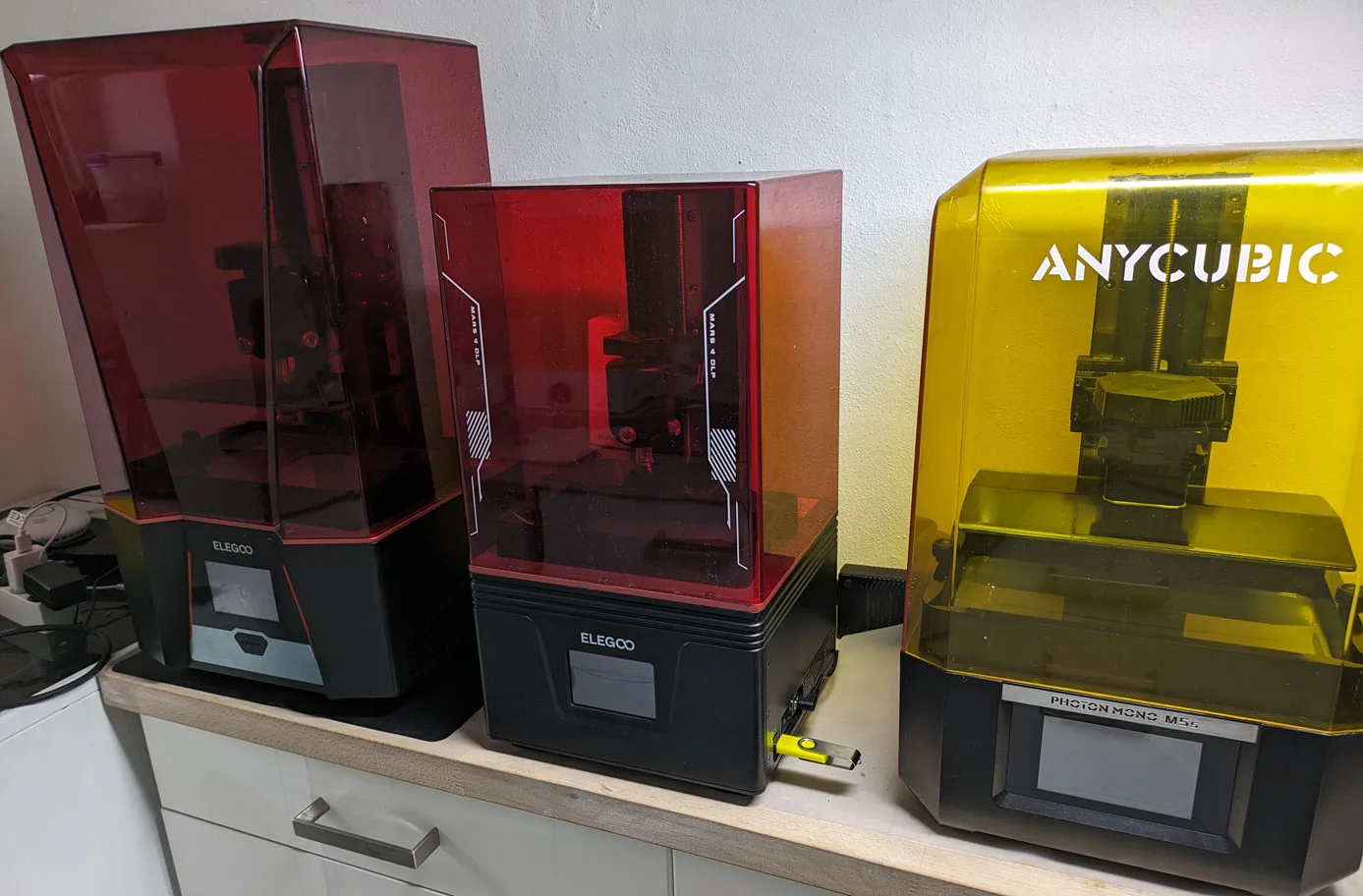
An entry-level printer costs around $149 for the Elegoo Mars 4aff. Add a wash and cure station at roughly $40 to $80. Add a bottle of resin at $25 to $35. Account for failed prints while you dial in your settings. The total sits in the $400 to $500 range before you have a reliable workflow.
At Games Workshop prices, that covers roughly 100 figures from a basic infantry kit. At indie creator preorder prices, the comparison point is roughly 200 figures. If you buy fewer than that per year, the maths of cost-saving resin printing does not work.
There is a second layer to the cost argument that often goes unmentioned. Once you have a printer, the ongoing cost of digital files adds up. Some creators sell one-off packs at $10 to $20 per release. Monthly Tribes subscriptions run $8 to $12 per creator. The hobbyist who subscribes to two or three creators per month may spend more on files each year than they would on the occasional GW box. That is not a disqualifying fact, but it belongs in the maths.
This is not an argument against resin printing. It is an argument against using cost-saving as the primary justification. The hobbyist who genuinely uses the printer every month for years will eventually be ahead. The hobbyist who prints a batch, loses interest for six weeks, and repeats that pattern will not.
The setup cost is real. Do not wave it away.
The catalogue access question
This is where resin printing earns its reputation, and where the case is genuinely strong for a large number of hobbyists.
Games Workshop makes excellent figures, but they do not make everything. They do not make:
- True-scale or Primaris-compatible Marine alternatives with specific loadouts
- Historical ranges in 28 mm from specific eras
- The full proxy ecosystem for rulesets like One Page Rules, Trench Crusade, or Stargrave
- Terrain and scatter scenery at the price point or aesthetic that many painters want
- Every conceivable D&D monster, NPC, or party member
The digital miniature catalogue on MyMiniFactory Tribes and Patreon is enormous and growing. Creators like Station Forge, Red Makers, Titan Forge, and Archvillain produce high-quality files specifically for home printing. The range available to a resin printer owner in 2026 is substantially wider than what any single manufacturer’s catalogue can provide.
If you paint a faction, genre, or aesthetic that the commercial market underserves, catalogue access is the genuine reason to own a printer. It is not about saving money. It is about having models that would otherwise not exist on your desk.
See choosing between slicers and manufacturer software for context on the digital ecosystem, including the Tribes subscription model and how files are typically delivered.
It is worth understanding what catalogue access does not cover. It does not cover official Games Workshop models. GW does not sell STL files and has no plans to. If the armies you want are specifically GW sculpts and nothing else will do, printing does not solve the problem. Catalogue access is the compelling argument for the hobbyist whose wants have outrun the commercial range, not the hobbyist who is fully satisfied by what the hobby shop stocks.
Also worth naming: the quality of independent digital releases varies considerably. The best creators produce files with pre-supported meshes, test prints, and responsive customer support. The worst sell files that require extensive work before they print cleanly. A Tribes or Patreon subscription reduces this risk because the creator’s track record is visible. One-off purchases from unknown creators on a marketplace are a gamble. This is not a dealbreaker, but it is a real variable that does not exist when you buy a box from a shop.
The time cost
The catalogue access argument looks strong until you add the time column.
Getting a reliable workflow in the first three months takes roughly 10 to 15 hours of setup, calibration, failed-print debugging, and wash-and-cure iteration. That time sits on top of your painting practice, not instead of it. For painters who are already stretched, this is material.
The specific shape of that learning time is worth spelling out. It is not ten hours of pleasant tinkering. It includes print failures that waste an hour of passive print time and a portion of a resin bottle. It includes a support-placement session that runs longer than expected. It includes reading a forum thread at 11pm to understand why the build plate adhesion is failing. Some painters find that process engaging. Others find it a frustrating detour from the actual hobby, which is painting.
After that initial investment, a repeat print from a dialled-in file takes maybe 20 minutes of active time per plate: pour resin, start print, come back, wash, cure, remove supports. The passive time (the print itself) runs three to eight hours depending on model height. The active time is low. The passive time means the printer is occupying space and chemical attention while it runs.
Some painters fit this naturally into their workflow: start a print, go paint something, come back and process the result. Others find the asynchronous nature annoying rather than convenient. Know which type you are before committing.
For an account of what the early experience actually looks like, brutally honest resin printing advice covers the specific surprises most beginners encounter.
The space cost
A resin printer needs a dedicated space. Not a corner of the kitchen table. A space you can leave a printer running, that has some ventilation, where IPA or wash water can be processed safely.
For apartment dwellers and renters this is not a trivial constraint. A printer on a balcony with a fan ducted out a window is workable. A printer in a bedroom without ventilation is not. If space is already tight, the space cost of a resin printer is a genuine reason to pause.
For hobbyists with a garage, a spare room, or a utility area, the space requirement is easy to meet. The constraint is real but it is not universal.
See the resin printing in an apartment guide for specific ventilation and placement advice if space is a concern.
When the answer is clearly no
The question “is resin printing worth it” has a clear no answer for a specific reader profile.
If you primarily paint the Games Workshop range and you are satisfied with it, the catalogue access argument does not apply to you. If you paint fewer than ten to fifteen figures per year, the cost-saving argument never works out. If you have no interest in calibration, troubleshooting, or optimising a process, the hobby-of-printing reason is not your reason. If you have no dedicated space and your living situation makes ventilation genuinely difficult, the practical constraints are real.
There is a version of resin printing enthusiasm that is mostly gear acquisition dressed up as a productivity argument. The hobbyist who buys a printer because printing seems like the next level of commitment, without a clear answer to “what will I print that I cannot already buy”, is likely to find the machine sitting unused after two months. The printer does not create the desire to paint more. If the painting queue is already stale, adding a printing step to the front of it does not solve the problem.
None of this is a criticism. GW boxes are excellent. Painting ten figures a year from a carefully curated range is a perfectly good hobby. Resin printing is not a default upgrade for every miniature painter. For this reader profile, resin printing is not worth it, and saying so directly is more useful than a gear list.
When the answer is clearly yes
The yes answer is equally clear for a different reader profile.
If you paint a faction or aesthetic that the commercial market cannot supply, printing gives you access to a catalogue the shop does not stock. If you print every week to keep your painting queue full, the setup cost pays off inside a year. If you genuinely enjoy the process side of hobbying, the printing is its own satisfying loop. If you have a garage, a utility room, or a well-ventilated spare space, the practical constraints are easy to clear.
For this profile, resin printing is worth it. The printer becomes infrastructure, the files become the expanding catalogue, and the painting practice deepens rather than competes with it.
The middle case: occasional printing
Many painters land in the middle. Not dedicated printers. Not casual buyers. Occasional printers who fill specific gaps.
A single Mars 4 at $149, run once a month to print the specific models you cannot source commercially, is a workable and genuinely useful setup. The printer does not need to justify itself through weekly volume. It justifies itself through the three resin Chaos Warriors you could not buy anywhere, or the historically accurate pike and shot infantry for the period campaign, or the dragon that was the right scale and the right design for the table.
Occasional printing at low volume is not a betrayal of the cost argument. It just means the justification is catalogue access, not economics, and that is a valid justification on its own.
The starter kit pointer
If you have worked through this framework and the answer is yes, the practical starting point is how to start resin printing miniatures, which covers what to buy, where to set it up, and what to skip in the first month.
The best resin 3D printer guide covers the full printer range with per-machine notes if you want to compare options before committing.
The verdict
Resin printing is worth it for the hobbyist who genuinely needs catalogue access the commercial market does not provide, or who wants the printing process as a second hobby alongside painting. The investment in time, space, and money pays back for that reader.
It is not worth it for the hobbyist who only prints GW ranges, buys fewer than a hundred figures a year, or has no interest in the process side of the craft.
Both answers are honest, and neither is a failing. The question “is resin printing worth it” has a different answer depending on which reader is asking it. The useful thing is to know which reader you are before you buy the printer.