Some links on this page are affiliate links — marked with aff — and if you buy through them I may earn a small commission at no extra cost to you. Read the full disclosure.
The cost-per-miniature question gets a fast, wrong answer on most forums: twenty pence in resin per Marine. The resin number is roughly right. The cost per miniature is roughly twice that. This article walks through where the rest of the money goes, with real figures rather than wishful ones.
Four cost buckets sit between you and a usable painted model: the resin itself, the failed prints, the consumables you burn through each session, and the capital cost of the printer and wash station spread across everything they produce. Most cost discussions count the first bucket and wave their hands at the other three. The wave is where the surprise comes from.
The four cost buckets
It helps to name the categories clearly so nothing hides in the rounding.
Resin is the obvious one. You pour it into the VAT, you print, you use a measurable amount per model. This is the number that gets quoted on forums.
Failed prints are the unobvious one. A failed print consumed resin, consumed FEP film wear, and consumed your time. None of that cost disappears when the print fails. It has to be distributed across the successful prints in the same session.
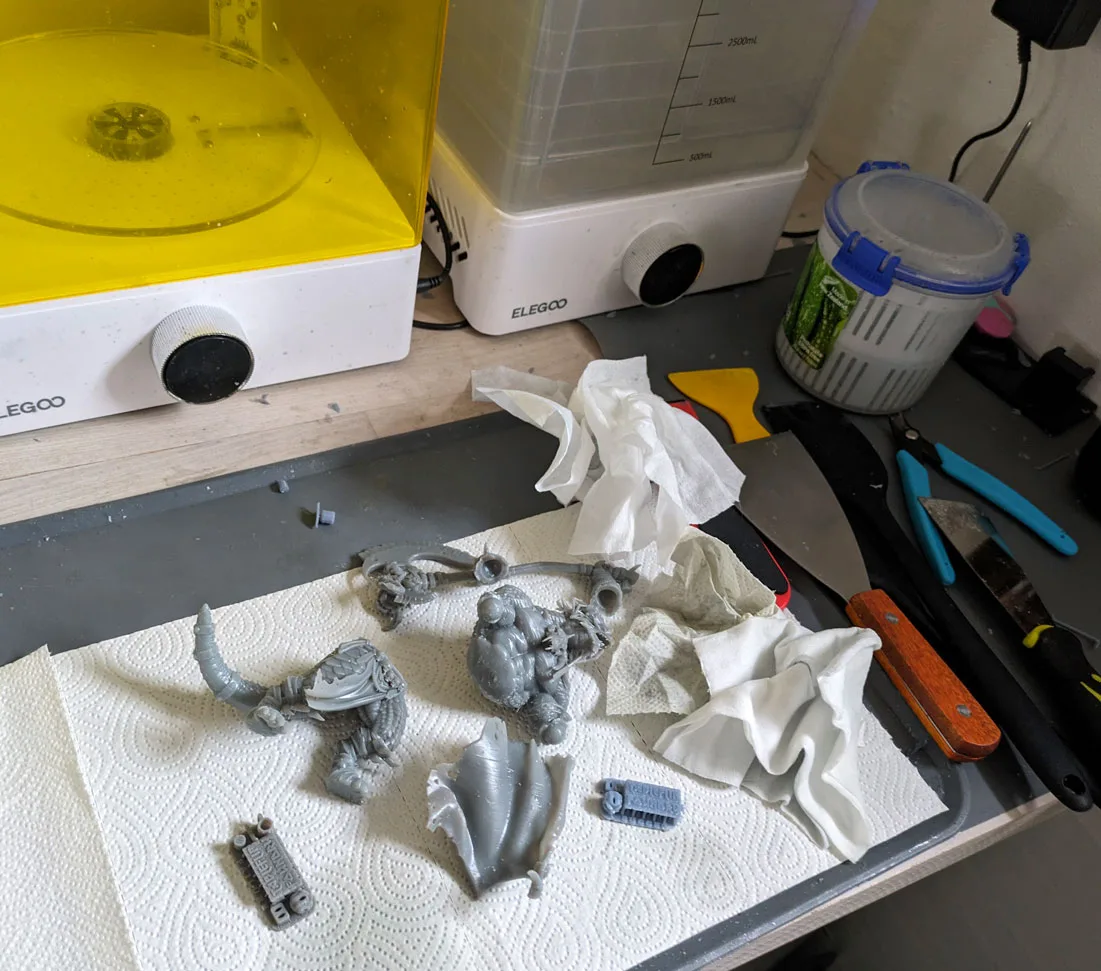
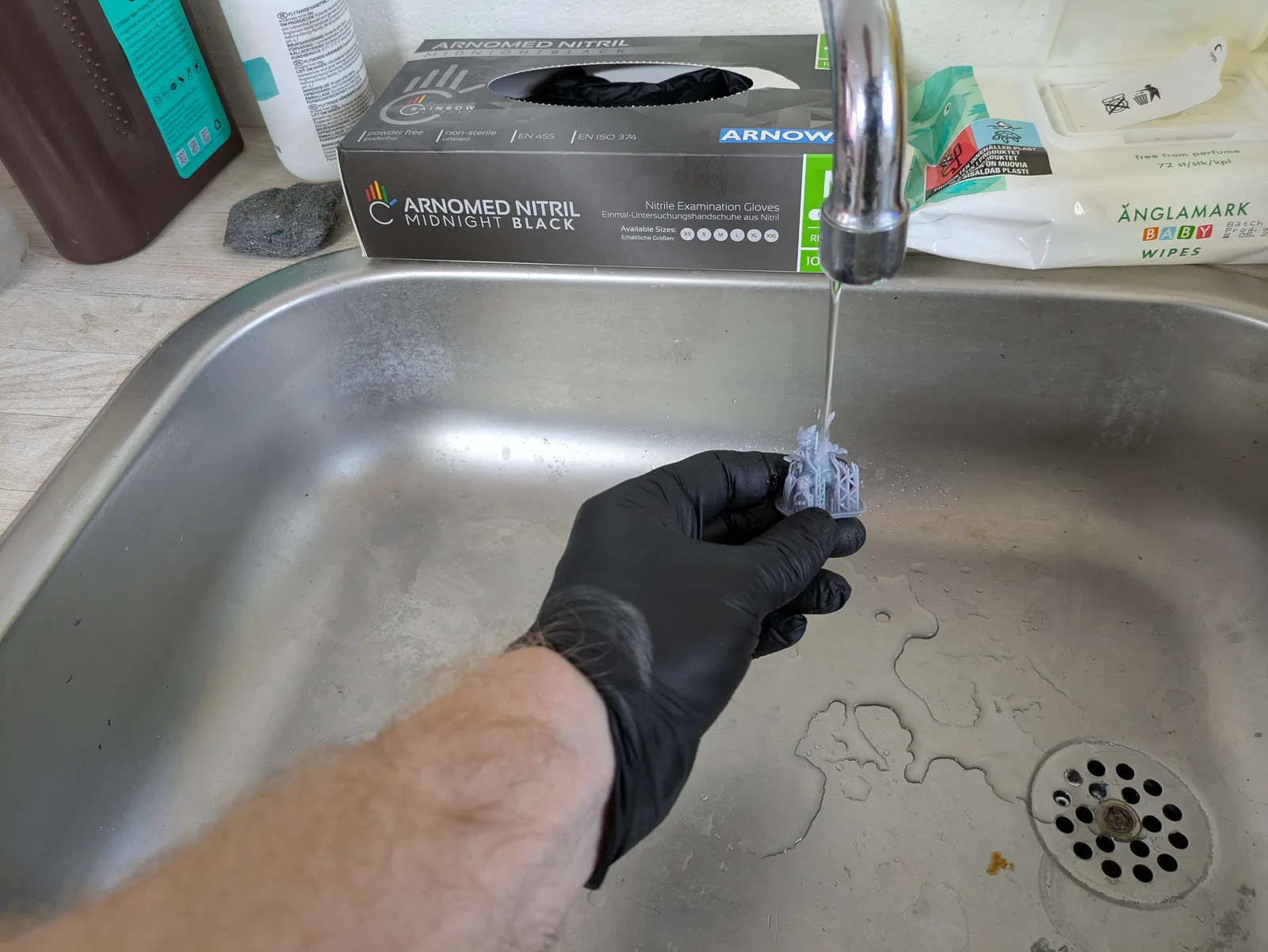
Consumables are the running costs of operating the printer: IPA or wash solution, nitrile gloves, paper towels, FEP film replacements, the build plate surface. Each of these is small per session; collectively they add up to a steady monthly outgoing that is easy to underestimate.
Capital amortisation is the printer itself, the wash and cure station, and the initial learning-curve spend on wasted resin and botched experiments. These costs are real, and they sit on top of the ongoing material costs until you have printed enough models to dilute them.
Resin cost per model
A standard 28 mm infantry model, tilted at 45 degrees on supports as it would be printed in a slicer, uses roughly 5 to 8 grams of resin. That range covers variation in model geometry: a slim ranger figure sits near 5 grams; a heavily armoured Astartes-style infantry model with a larger silhouette sits near 8 grams. Call it 6 grams as a working figure for most infantry.
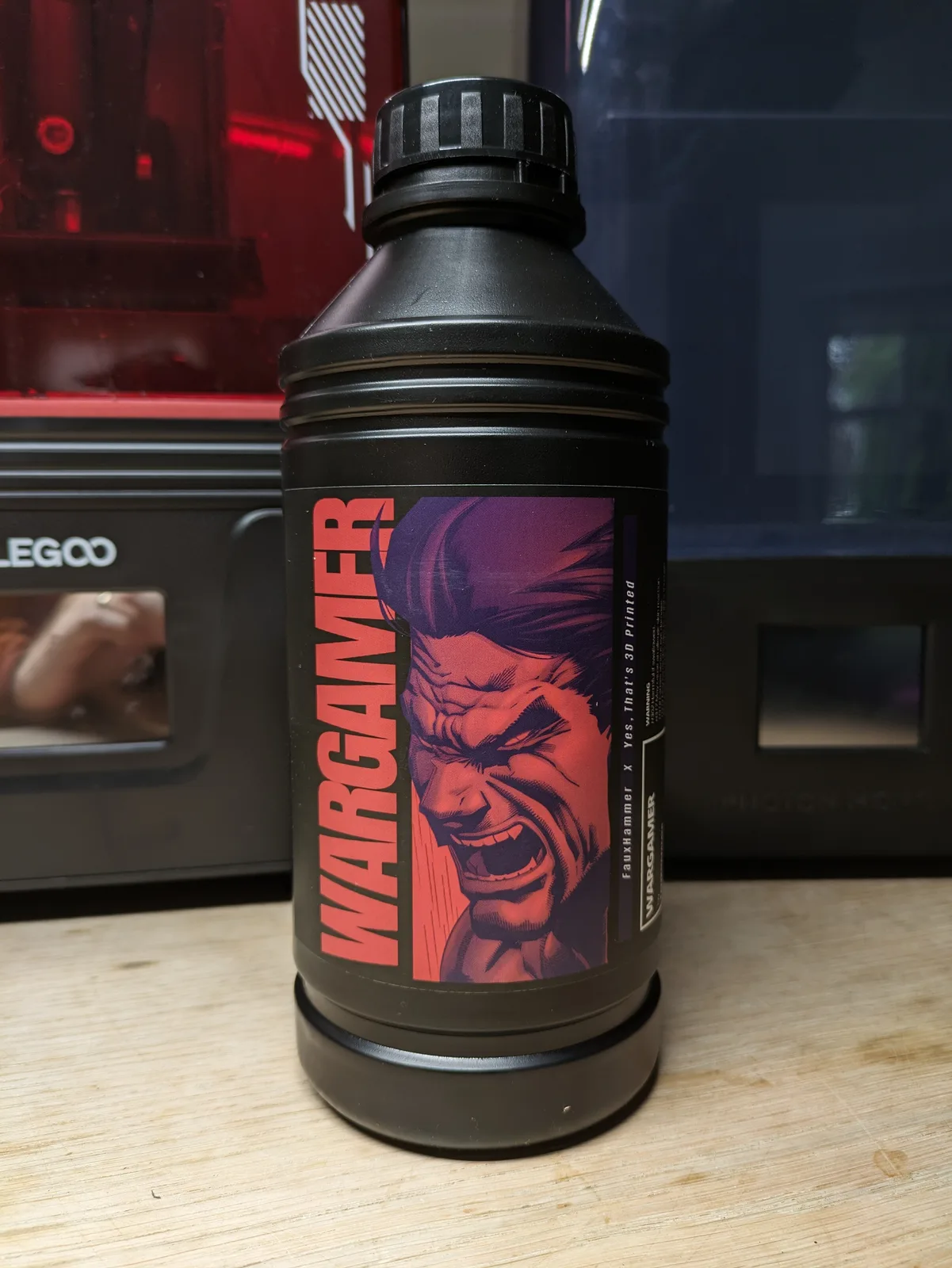
A kilogram of resin at a reliable mid-tier brand such as Wargamer Resinaff or AmeraLabs TGM-7aff costs roughly $40 per bottle. That works out to 4 cents per gram, or roughly 24 to 32 cents per infantry model in raw resin.
The forum answer of “twenty pence per Marine” is in this territory. It is not wrong; it is just incomplete.
At the premium end, speciality resins designed for fine miniature detail cost $50 to $60 per kilogram. The resin cost per model scales linearly: roughly 30 to 48 cents per infantry model. Still low, but no longer negligible at volume.
The failed-print tax
Beginners run a failure rate of roughly 30 to 50 percent in the first month. That is not an exaggeration or a scare figure; it reflects the learning curve on exposure settings, support placement, and build-plate adhesion before they are dialled in. After the first month the rate falls sharply, landing around 5 to 10 percent for a printer who has found their settings.
Across a full year, accounting for the learning phase, the average failure rate sits closer to 10 percent. That does not sound large, but its effect on cost-per-model is direct. At 30 cents of resin per model and a 10 percent failure rate, the effective resin cost per usable model rises to roughly 33 cents.
More significant is the failure rate in the first two months. A 40 percent failure rate during the learning phase means nearly half your resin goes to waste. The actual cost per usable model during that period is closer to 50 cents in resin alone. Plan for that period rather than being surprised by it.
The cost figures in this article are steady-state figures for a printer who has passed the learning curve. Year-one costs are higher, and the first month is the most expensive month of printing you will ever have.
Consumables
This bucket surprises most new printers because each item is cheap individually and the list feels short. Over a month of regular printing the total is not trivial.
IPA or wash solution. A printer who washes by hand in a small tub uses roughly one litre of IPA per month. At roughly $10 to $15 per litre of cleaning-grade IPA, that is $10 to $15 per month. A wash and cure station that recirculates solution reduces consumption but not to zero.
FEP film. The FEP is the transparent layer at the bottom of the resin VAT. It wears with each print and needs replacing every two to three litres of resin. A standard FEP replacement costs $5 to $8. For a printer running two sessions per week, a replacement roughly every 5 to 7 weeks. Per model, FEP wear adds a few cents.
Gloves and paper towels. One pair of nitrile gloves per session, a roll of paper towels per fortnight. Small per item; steady over a month.
Taken together, consumables for a regular printer running two or three sessions per week cost roughly $10 per month. Spread across the usable models that month, that adds roughly $1 per model on a typical batch.
Capital cost amortisation
The printer, the wash and cure station, and the early-ownership learning cost are all real expenditures that have to be recovered across the models they produce.
An entry-level Mars-class printer costs roughly $150 to $200. A wash and cure station costs roughly $40 to $80 at the basic end, up to $120 to $200 for a unit with a proper rotation arm and sealed lid. The initial spend on failed experiments, wasted bottles of resin, and early calibration prints adds a further $50 to $100 that most buyers do not account for in the headline setup figure.
Total initial kit cost sits at roughly $400 for a minimal setup. A more considered setup with a better wash station and some margin for early-stage waste sits closer to $500.
Amortised across 200 usable models in year one, that is $2 to $2.50 per model from capital cost alone. At 400 usable models in year one, it halves to roughly $1 to $1.25 per model.
In year two and beyond, the printer is paid off. Capital cost drops to near zero unless a major component fails. The LCD screen costs roughly $30 to $80 to replace and typically lasts one to two years of regular use. That adds roughly 10 to 20 cents per model in year two on a heavily used printer, less on a moderate user.
Year one is the expensive year.
The cost per miniature
Adding the four buckets together gives a picture that is more useful than the forum shorthand.
Year one, steady-state phase (post-learning-curve):
- Resin: roughly 30 to 35 cents per usable model (including failure tax)
- Consumables: roughly $1 per model on a batch of around 10 to 12 models
- Capital amortisation: roughly $2 per model at 200 models per year
Total: roughly $1.50 to $2 per usable 28 mm infantry model in year one.
Year two and beyond, printer paid off:
- Resin: roughly 30 to 35 cents
- Consumables: roughly $1 per model in batch
- Capital: near zero (occasional LCD replacement adds maybe 10 to 15 cents per model)
Total: roughly 60 to 80 cents per usable model in year two.
Year three and beyond, once the slicer is fully dialled in and failure rate is minimal:
Total: closer to 50 cents per usable 28 mm infantry model.
The steady decline from $2 to 50 cents over three years is the actual shape of the cost curve. Year one is not the fair comparison year. Year three is.
Comparison to commercial alternatives
Games Workshop unit boxes cost roughly $25 to $30 for ten basic infantry models, which works out to $2.50 to $3 per model. That is the comparison point most people reach for.
At year-one resin costs of $1.50 to $2 per model, printing is slightly cheaper than GW even in the first year, but only marginally. Across 100 models in year one, the saving is roughly $50 to $100 total.
The more realistic comparison is Patreon and Tribes subscription digital creators, who sell pre-paint files at roughly $1 to $1.50 per model equivalent when subscription costs are spread across a month’s releases. Against that baseline, year-one resin printing sits at rough parity or slightly above depending on volume. By year two it is clearly cheaper.
Break-even against GW pricing sits at roughly 100 models in year one. Break-even against indie pre-paint creators sits at roughly 200 models.
Below those thresholds, resin printing does not save money compared to its nearest commercial alternatives. Above them, it does.
The hidden cost: time
Time does not show up in the cost maths but it is the cost that sinks most printing hobbies.
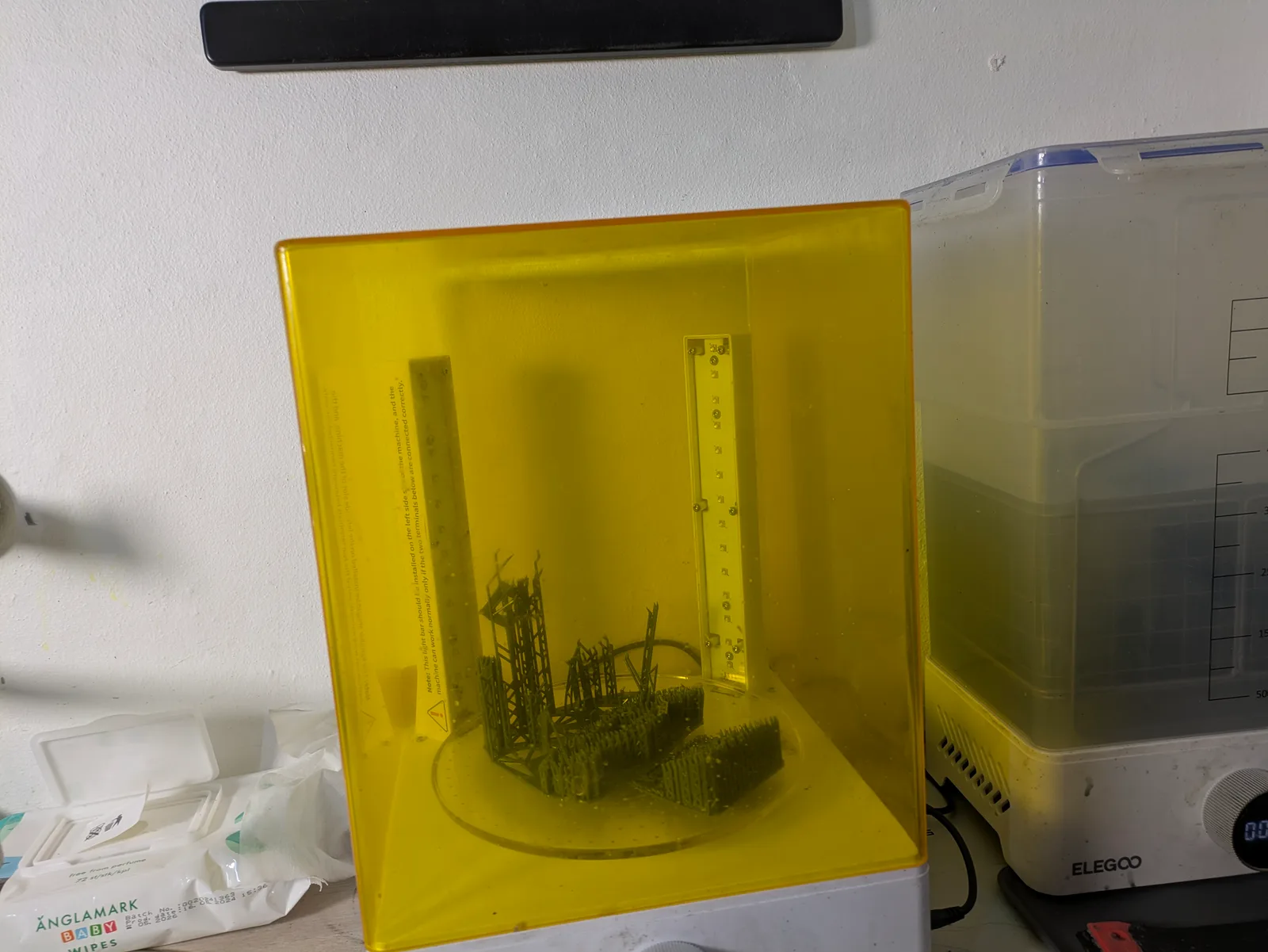
A batch of twelve infantry models requires roughly 20 to 30 minutes of slicer setup, seven to nine hours of overnight print time, and 30 to 40 minutes of post-processing the following morning. Total human time per batch: roughly 50 to 70 minutes spread across two sessions. Per usable model, that is roughly 5 minutes of active human time.
That 5 minutes does not feel like a burden per model. It becomes a burden when the printer is not part of a settled weekly workflow. If the printer sits idle for three weeks and then needs a full session to remember the setup, the per-model time cost climbs. If a print fails overnight and the next session needs replanning, it climbs again.
The hobbyist who builds print-and-process into a regular evening habit finds the time cost genuinely low. The hobbyist who picks up the printer intermittently finds it higher than the per-model figure suggests.
Where the cost can spike
The figures in this article assume a standard setup running mid-tier resin with a normal failure rate. Several variables push the cost higher.
Speciality resin. Premium resins formulated for fine miniature detail cost $50 to $60 per kilogram rather than $40. That increases the resin cost per model by roughly 25 to 50 percent. At thirty models per month, the difference is around $3 to $5 more per month. Not catastrophic, but not nothing.
ACF or nFEP film. Higher-end release films cost roughly double the standard FEP but last noticeably longer. The per-model cost works out roughly the same over time.
LCD replacement. A printer running five or six sessions per week will need an LCD replacement more frequently than a moderate user. At $30 to $80 per screen, with a replacement interval of one to two years at moderate use, the annualised cost per model is low but not zero on a heavily used machine.
Scale creep. The 5 to 8 gram figure applies to 28 mm infantry. A 75 mm dragon or large vehicle can consume 80 to 120 grams. At 4 cents per gram, that is $3 to $5 in resin for one model. Worth knowing before you print a fleet.
The summary
Resin printing costs roughly $1.50 to $2 per usable 28 mm infantry model in year one, falling to roughly 60 to 80 cents in year two, and closer to 50 cents by year three.
That is cheaper than Games Workshop infantry prices ($2.50 to $3 per model) from year one, but only by a meaningful margin after you have printed roughly 100 models. It is cheaper than indie pre-paint creator pricing ($1 to $1.50 per model equivalent) only after you have printed roughly 200 models.
Below those thresholds, the maths of cost-saving resin printing does not work. The printer is a catalogue-access tool, not a money-saving tool, until volume catches up with the setup cost. That distinction matters because it sets the right expectation for whether and how fast the investment pays off.
If you want to plug in your own numbers, the resin cost calculator does the maths interactively with the same defaults this article uses.
See is resin printing worth it for tabletop miniatures for the broader question of whether catalogue access and time cost justify a printer for your situation. Resin 3D printing for miniatures is the full overview if you are still working through the fundamentals.
For the setup itself, how to start resin printing miniatures covers the first-month waste and how to reduce it. The best resin for miniatures covers which resins give the best results at each price point once you are ready to choose. For specific machine comparisons, the best resin 3D printer guide has per-machine notes.