The forum consensus on resin versus FDM costs is that resin is the more expensive technology and FDM is the budget option. That is roughly right per gram and roughly wrong per terrain set. The set-level cost depends as much on how you run the workflow as it does on the cost of the material itself. What follows works through the full picture: what a terrain set actually costs in each technology, where the hidden expenses come from, and how to use that framework when planning future builds.
Specific per-gram or per-kilogram prices are not cited here because they shift with promotions, regional availability, and batch sizes. The proportions are what matter, and the proportions are stable enough to be useful.
The cost framework
A fair comparison between resin and FDM at the terrain-set level needs six categories. Material cost per gram is only one of them.
Material cost. The cost of the resin or filament that becomes the printed piece. The starting point everyone uses, and genuinely where the gap between the technologies is most visible. Resin runs roughly two to three times the per-gram cost of standard PLA filament. Economy resins narrow the gap but also introduce more print variability.
Support overhead. The material consumed as supports rather than as the printed piece. FDM terrain designed for flat printing has very low support overhead, sometimes near zero. Resin terrain with overhangs, undercuts, and character-scale detail can carry a support overhead of 30 to 40% of the total resin consumed per plate. The material cost line item needs the support overhead folded in to be honest.
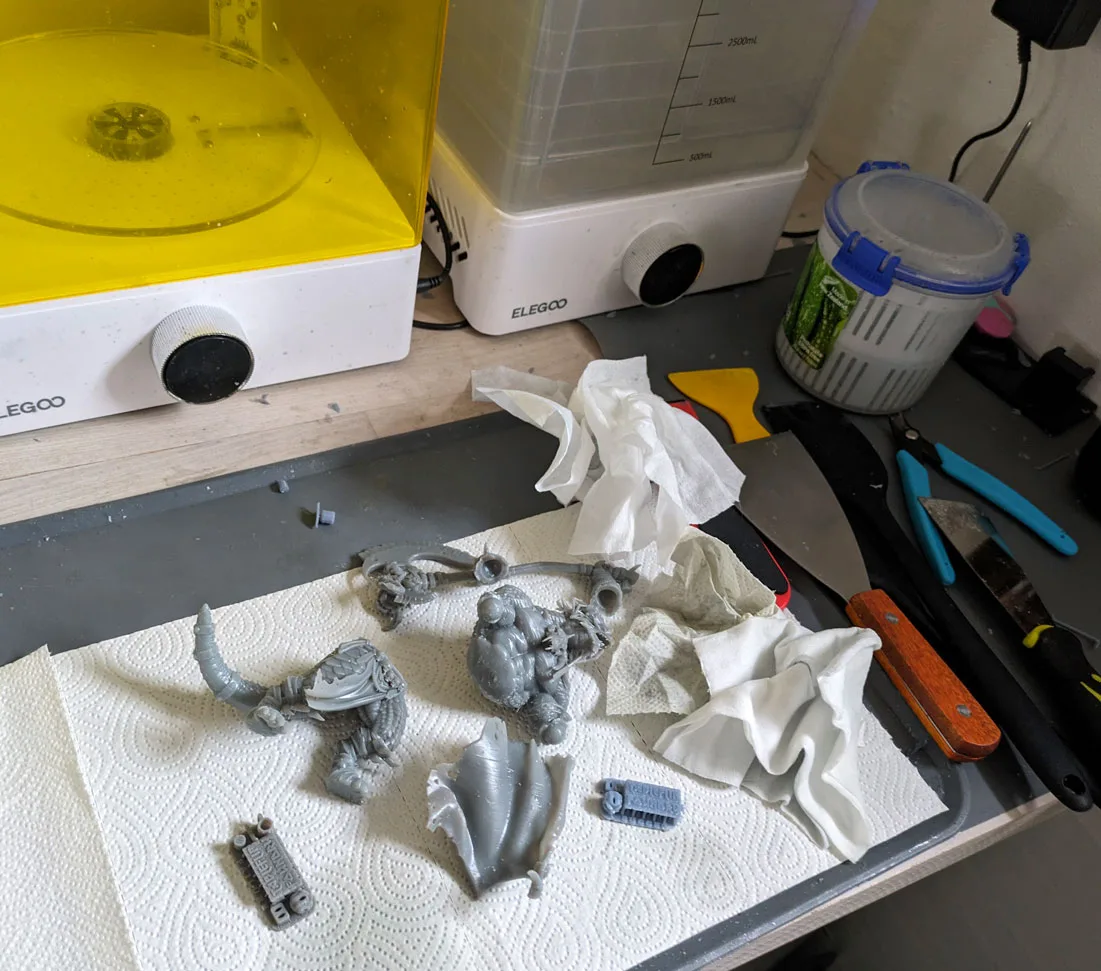
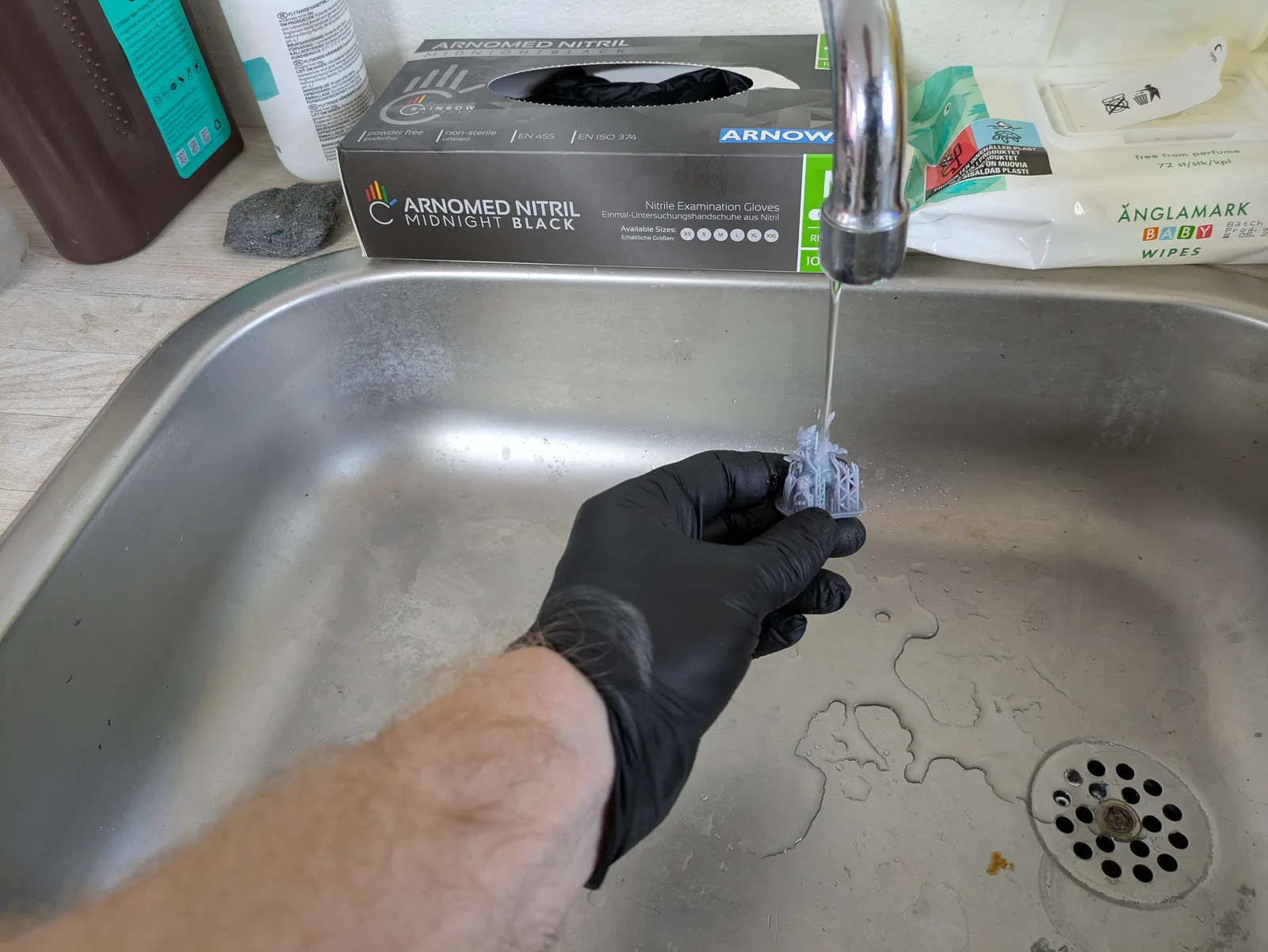
Consumables. FDM consumables are modest: build plates wear slowly and are replaced every six months to a year of regular use, nozzles last months on standard PLA, and the only regular consumable is the filament itself. Resin consumables are more significant: FEP film replaces every one to three months depending on print volume, IPA or wash medium depletes with each plate, gloves and paper towels are consumed in every session, and the build plate eventually needs resurfacing or replacement. Over a full terrain project, the consumable cost for a resin workflow is meaningfully higher than the base material cost suggests.
Electricity. Both technologies consume electricity, and neither is the dominant cost. An FDM print running for eight hours at typical wattage costs less than a coffee. Resin UV exposure and the wash and cure station add comparable cost. Neither technology is worth optimising for electricity alone. Include it in the framework for completeness, not as a decision driver.
Hardware depreciation. FDM machines have fewer consumable parts than resin machines. A nozzle, a build plate, and occasional belt or motor replacement cover most of a year of regular FDM printing. Resin machines carry a higher depreciation load: FEP, screens, build plates, and in the case of tilt-VAT designs, the tilt mechanism itself. A resin printer screen typically lasts one to three years of regular use before the pixel uniformity degrades enough to affect print quality. The lifetime cost per piece is lower on FDM at hobbyist print volumes.
Time. Time is a cost. FDM post-processing for terrain is minimal: remove the brim, deflash any support stubs, run a quick visual check. The piece is ready to prime within minutes of coming off the bed. Resin post-processing is a committed 20 to 40 minutes per plate: wash cycle, cure cycle, support removal, allow the alcohol to evaporate, inspect and touch up. Multiplied over 30 plates of a dungeon terrain set, that post-processing time is a real labour cost. Whether it is a meaningful cost depends on how you value your hobby time, but it is not zero.
A worked example: a four-room dungeon kit in FDM
Imagine a dungeon-crawl terrain set sufficient to run a four-room adventuring session: floor tiles, wall sections, a door or two, and some scatter. This is a representative terrain project, not a heroic undertaking.
On an FDM printer, this kind of set uses roughly 1.5 to 2 kg of PLA filament for the structural pieces. Brim and skirt waste is under 5% for typical modular terrain pieces, because flat-bottomed tiles print without brims on many setups. No support waste on most modular tile designs. The build plate replacement cost is a fraction of the project; plates on a well-run FDM printer last months. Electricity cost is low. Per-piece post-processing is remove and deflash, measured in seconds per piece.
The hobbyist time for the FDM print run itself is also low in active terms. You set up the plate, start the print, and come back when it is done. Supervision time is minimal on a well-dialled machine. The actual hands-on labour for a full dungeon set is dominated by assembly, painting preparation, and the decisions about what goes where, not by printing itself.
Total material and consumable cost for this set is low relative to the visual output. FDM terrain at this scale is one of the best value-for-money propositions in the hobby.
A worked example: the same dungeon kit in resin
The same four-room dungeon kit in resin produces a different cost picture at every line item.
Material volume is lower because resin has higher density than PLA and the pieces are typically hollow or printed at smaller scale. But resin costs roughly two to three times as much per gram, so the raw material cost is higher even on less mass. Support overhead of 30 to 40% adds to that number directly: a meaningful fraction of the resin you consume becomes supports and waste rather than a piece on the table.
Consumable costs add up fast on a busy resin project. FEP film at this print volume may need replacing once or twice. IPA or wash medium is consumed with every plate wash. Gloves and paper towels are real consumables, not rounding errors, on a multi-week terrain project. Build plate surface condition matters for adhesion and may need attention partway through.
Post-processing time for 30 resin plates at 30 minutes per plate is 15 hours of hands-on hobbyist time. That is a substantial commitment over a terrain project, and it is entirely invisible in any per-gram cost comparison.
Time costs compared directly
It is worth being concrete about the time comparison because it shapes the hybrid approach many hobbyists eventually settle on.
FDM terrain: print runs unattended overnight or during the day. Post-processing per plate is 5 to 10 minutes of active time. A full terrain project of 20 to 30 plates involves perhaps 3 to 5 hours of post-processing total, spread over two or three weeks.
Resin terrain: print runs unattended overnight or during the day. Post-processing per plate is 20 to 40 minutes of active time. The same 20 to 30 plate project involves 8 to 20 hours of post-processing total. That difference is not a small rounding error.
For terrain specifically, where print volume is high and per-piece detail requirements vary, the time cost argument often tips the bulk of a set toward FDM even for hobbyists who clearly prefer the resin workflow for miniatures.
Hardware depreciation compared directly
This is the cost category that surprises most new hobbyists most severely, and it favours FDM significantly at hobbyist print volumes.
A resin printer screen is the dominant depreciation item. At high print volumes, a screen may need replacement once a year or more frequently. Screen replacement costs vary by printer model but are not negligible. A tilt-VAT mechanism adds further wear. FEP replacement at one to three sheets per month for a busy printer adds an ongoing consumable cost that accumulates over a year.
An FDM printer’s dominant wear items are the nozzle (cheap, lasts months on standard PLA), the build plate (cheap, lasts six months to a year), and the occasional belt or motor issue on aggressively run machines. The total hardware depreciation per piece on FDM is lower at hobbyist print volumes, often significantly so.
The hidden cost: failed prints
This is the cost category that the per-gram comparison misses entirely, and it is the most significant argument for FDM on high-volume terrain projects.
A failed resin print can range in cost from a small amount of wasted resin and 30 minutes of post-processing, to a full plate of failed models plus FEP damage from resin curing onto the film during the failure, to, in worst cases, screen damage from a catastrophic failure. The cost of a failed resin print is highly variable but has a meaningful upside tail.
A failed FDM print is a brim in the bin, a few hours of lost print time, and a mental note to check the Z offset before the next session. The cost ceiling for an FDM failure is low.
Over a full terrain project at hobbyist scale, the reliability advantage of FDM reduces the expected number of expensive failures significantly. This is not a criticism of resin printing; it is a structural difference between the technologies that belongs in any full cost comparison.
The verdict per terrain category
Given the full cost picture, the verdict by terrain category is:
Bulk walls and floors. FDM wins by a wide margin on material cost, consumable cost, time cost, and reliability. There is no compelling case for printing modular dungeon floors in resin unless you specifically need the surface resolution for a textured stone effect that FDM cannot produce.
Hero pieces and ornate detail scatter. Resin earns its cost here. A $30 spend on resin for a gargoyle, an ornate door, and a set of decorative keystones produces a visual return that $30 of FDM terrain cannot match. The detail resolution is the justification and it is a real one at these scales.
Modular base sets. FDM wins. Volume, flat printing, durability, and low post-processing time all point the same direction. The hybrid terrain article covers how to plan a set that uses each technology where it belongs.
Large centrepiece terrain. FDM wins once the piece exceeds the size threshold where resin’s hollow-printing penalties compound. This is covered in detail in when resin stops being worth it for bigger pieces.
For the full picture on printers at different price points for each technology, the best 3D printer for terrain and best 3D printer for miniatures guides cover the current hardware options.
The real cost-saver: not buying twice
The single largest cost event in most terrain projects is not the material cost per gram. It is re-printing failed or damaged pieces, re-buying a set that did not survive transport, or re-doing work because the first approach was the wrong tool for the job.
On the resin side, a carelessly run resin session that leaves liquid resin inside a hollow piece is a cracking failure waiting to happen. Reprinting the piece costs the full material and time budget of the original print. The printing bigger and hollow resin miniatures article covers the drainage and cure requirements that prevent this failure mode.
On the FDM side, a re-printed plate because of adhesion failure at two in the morning is the most common single-event cost spike. Good plate and Z-offset maintenance eliminates most of these.
The cost-saving advice for terrain in either technology is: invest the small amount of time to set up correctly once, and you will not pay the larger cost of doing it twice.
Closing
The per-gram comparison between resin and FDM is a starting point, not an answer. The full cost of a terrain set includes support overhead, consumables, post-processing time, hardware depreciation, and the expected cost of failed prints. When all six categories are in view, FDM is the more economical choice for bulk structural terrain, and resin earns its premium specifically for high-detail hero pieces. A hybrid set that uses each technology for what it does best is both the better-looking and the lower-cost option for most tabletop terrain projects. For the full decision framework on choosing between the technologies, see resin or FDM for tabletop terrain.