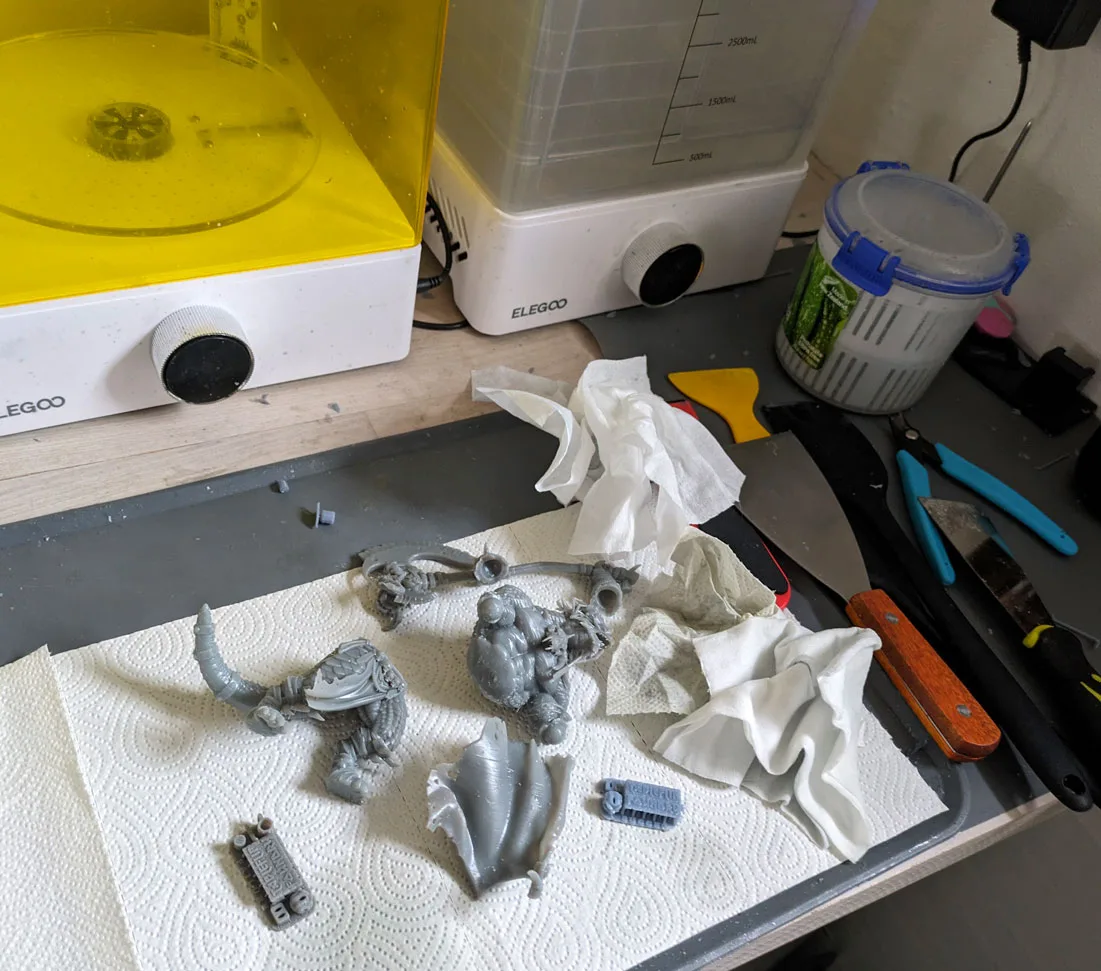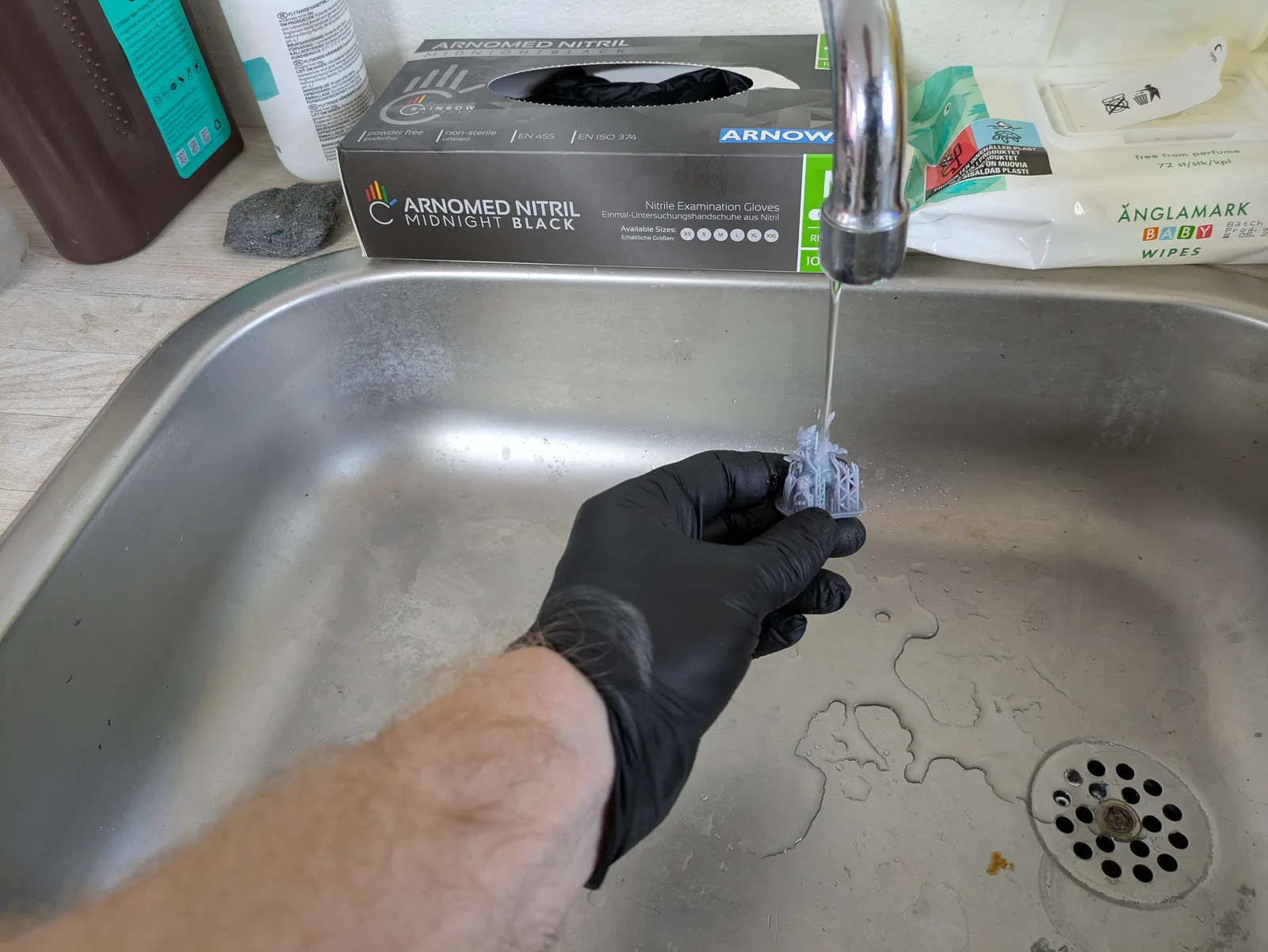
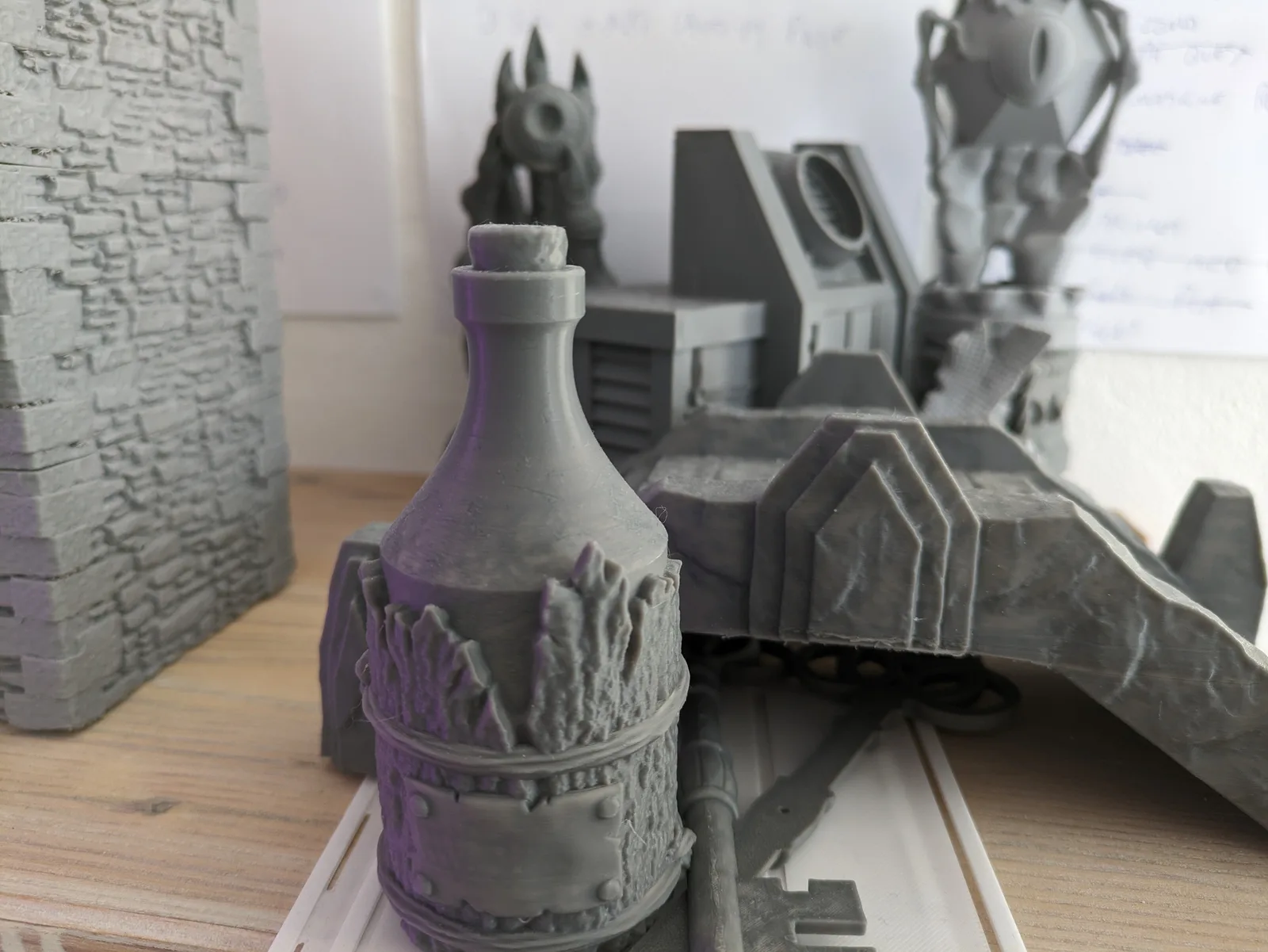
For years I refused to take FDM seriously. My logic was simple: I print miniatures, miniatures need sharp detail, and FDM layer lines ruin that detail. Resin was the obvious answer and I stuck with it. Then a friend put a large terrain set on the table that he had printed at 0.08 mm layer height on an FDM machine, primed it with a heavy textured primer, and I could not tell which technology had produced it at normal viewing distance.
That experience started a shift in how I think about the resin versus FDM question for terrain specifically. It comes down to four variables: the level of detail the piece actually needs, the size of the piece, how much abuse it will take on a gaming table, and what the cost per piece looks like.
If you want the single-sentence answer: resin for hero pieces and high-detail scatter, FDM for bulk playable terrain. But that one liner skips a lot of nuance, so read on.
What terrain means here
The word terrain covers an enormous range of pieces. At the small end you have scatter items: barrels, crates, lamp posts, small statues, decorative debris. At the middle range you have modular dungeon or battlefield tiles, walls, towers, and multi-piece kits. At the large end you have centrepiece boards, fortress walls, starship interior modules, and anything that takes up a meaningful fraction of a 4x4 table.
These three categories pull the resin versus FDM decision in different directions. Scatter items are small, often detailed, and can be printed on a resin bed in batches of dozens. Large centrepieces push hard against resin’s build-volume limits and hollow-printing complexity. Modular tile sets sit in the middle and are genuinely competitive ground for both technologies.
The four variables tell you which way each category tilts.
The four variables that move the decision
1. Detail level
Resin printers operate at resolutions that FDM machines cannot match. The practical resolution advantage shows up on: fine text and runes, facial features on character pieces, sub-millimetre texture on stone and wood surfaces, thin filigree and armour scroll work.
FDM layer lines are visible at close inspection even at 0.08 mm, and at coarser settings they are plainly visible from arm’s length. A heavy coat of textured spray primer closes some of that gap because the texture breaks up the uniform layer pattern. But if you are printing a piece that will be held in the hand and examined, resin wins by a margin that no primer or post-processing trick fully closes.
The question to ask: at what distance will this piece be read by the people at the table? A piece viewed at 50 cm across the table needs far less surface resolution than one that sits in someone’s hand. That view-distance rule is what makes FDM more competitive for terrain than for miniatures. Terrain is mostly read from 30 to 60 cm. Most miniatures are held.
2. Piece size
This is where FDM wins cleanly. Consumer resin printers max out at roughly 20 to 22 cm in their longest axis on a mid-range machine. Print a large piece and you are either hollow-printing with drain holes, or you are printing it in sections and gluing. Both routes add complexity and failure modes.
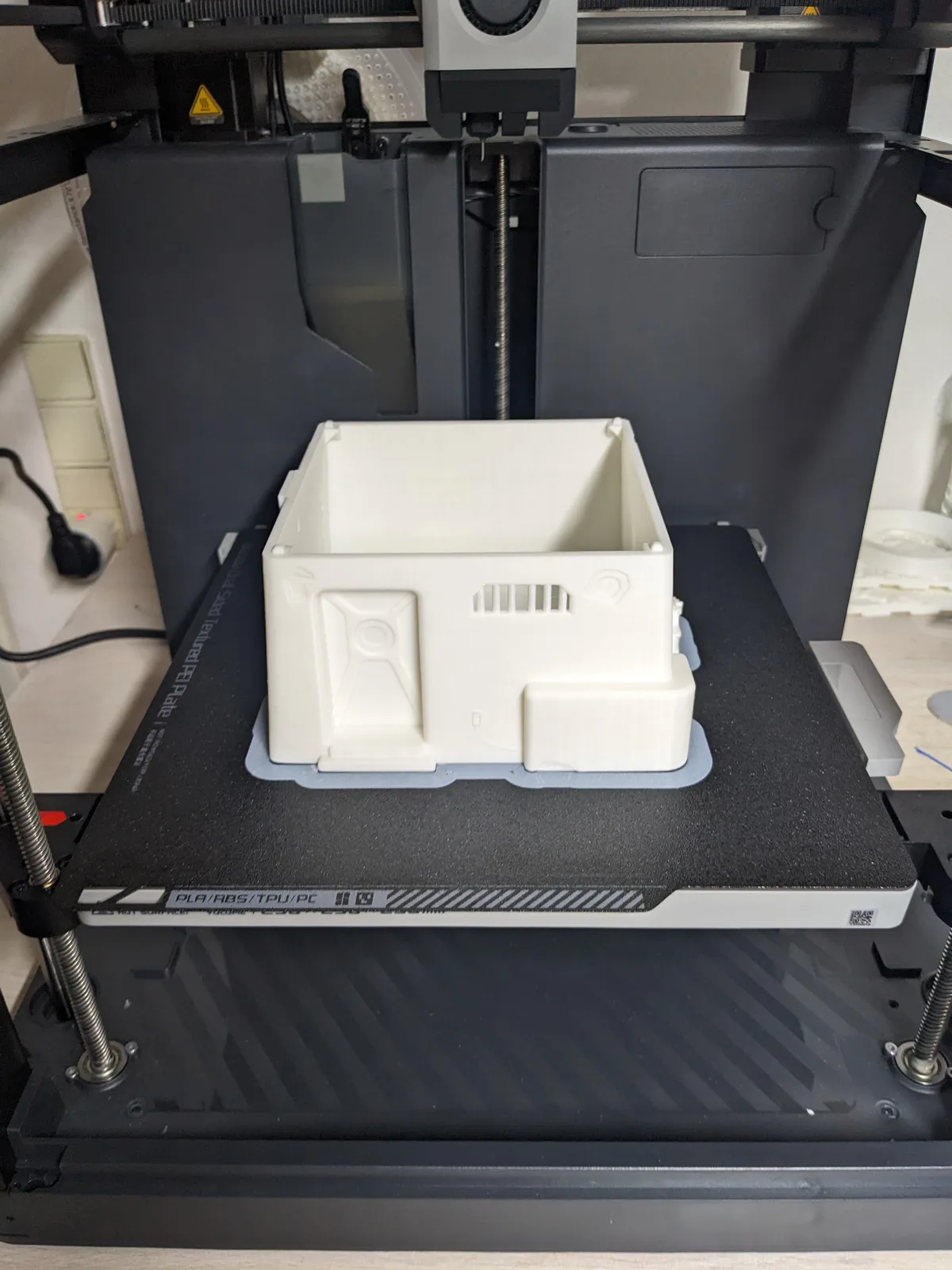
FDM machines in the same price bracket offer build volumes in the 25 to 30 cm cube range, and nothing about the technology penalises you for using all of it. A full-length fortress wall, a 20 cm diameter circular dais, a large starship bulkhead section: these print in one piece on a mid-range FDM without the hollow-printing penalty.
The honest crossover point for resin is roughly 10 cm in any single axis. Below that, resin is competitive. Above it, you are fighting your printer. That is not a hard rule; some hobbyists happily hollow-print large resin pieces with excellent drainage geometry. But as a default heuristic for deciding which printer to reach for, the 10 cm rule is reliable.
For the hollow-printing topic specifically, the article on printing bigger and hollow resin miniatures walks through the drainage hole requirements and the cracking risk with water-washable resins in detail. That applies equally to terrain pieces.
3. Durability
Standard miniature resin is brittle. It chips, it snaps at thin cross-sections, and it can crack under the kind of casual abuse a gaming table delivers: pieces knocked over, terrain bins emptied and repacked, games that run long and get packed up in the dark. Painted resin terrain that gets handled regularly develops paint chips more readily than FDM terrain in the same painted state.
PLA is meaningfully tougher for gaming-table use. Printed pieces flex slightly rather than snapping, and while PLA is not indestructible, a knocked-over FDM wall is more likely to bounce than a resin statue.
PETG and PLA-CF (carbon fibre PLA) push durability further. PETG handles transport stress better than standard PLA and tolerates mild temperature variation without warping. PLA-CF adds stiffness and impact resistance at the cost of requiring a hardened nozzle. For terrain that will live in a carry case, slide into foam cut-outs, and travel between gaming locations, PETG or PLA-CF on an FDM machine is a genuinely practical choice.
Tougher resins do exist. ABS-like resins (not the same as ABS filament) are less brittle than standard grey miniature resin and are a reasonable choice for terrain that needs to survive handling. But gram for gram, even ABS-like resin is more brittle than PLA, and the cost per gram is considerably higher.
4. Cost
This section deliberately avoids specific per-gram prices because they shift with promotions, regional pricing, and batch sizes. The proportions are what matter.
Miniature-grade resin is substantially more expensive per gram than standard PLA filament. The gap narrows somewhat with economy resins, but economy resins tend to produce more print failures and are more variable in cure behaviour. For terrain, where print volume per session is large, that cost gap matters.
The second half of the cost equation is support overhead. Terrain pieces often print flat-side-down with minimal support on FDM. Resin terrain with undercuts, overhangs, and interior cavities can require extensive supports, which consume resin that is not the printed piece. On a large hollowed resin terrain piece, a meaningful fraction of the resin you consume becomes supports and waste rather than part.
A worked comparison: imagine a four-room dungeon tile set, the sort of thing a tabletop hobbyist might produce to run a dungeon-crawl campaign. The resin version costs roughly three to four times as much in consumables as the PLA version, and takes longer per piece due to post-processing. The FDM version pops off the bed and is ready for priming the same day.
Time is also a cost. Resin post-processing is roughly 30 minutes per plate: wash cycle, cure cycle, support removal, alcohol evaporation, drying. FDM post-processing for terrain is closer to removing the brim and checking for stringing. Over a terrain project of any scale, that time adds up.
Detail crossover: when FDM stops being enough
The texture that separates resin from FDM for terrain purposes tends to show up in these categories:
Individual brick courses with visible mortar lines and weathering detail on each brick face. At 0.08 mm FDM layer height, horizontal texture reads well. Vertical texture on the face of a brick is where layer lines show.
Wood grain running parallel to the print axis. Wood grain running perpendicular to the print axis can be captured by layer lines intentionally, but it requires design intent rather than happy accident.
Runic carvings and inscriptions under roughly 3 mm in character height. Below that scale, FDM layer lines and nozzle width interact poorly with fine engraved geometry.
Faces and figurative sculpture embedded in terrain (a gargoyle corbel, a bas-relief hero face on a column). These are miniature-class work embedded in terrain-class objects. The face needs resin even if the wall does not.
The practical answer: if your terrain file is tile floors, plain stone walls, basic scatter, and modular dungeon sets designed for FDM, a well-tuned FDM printer is more than adequate. If the file is a sculptor’s ornate centrepiece piece with fine filigree, inscriptions, and character detail embedded throughout, resin gives you what FDM cannot.
The hybrid case
Most serious terrain hobbyists who have owned both technologies eventually run them together. The workflow is straightforward: FDM produces the structural bulk, resin produces the detail accent pieces.
A practical example: an FDM printer builds the walls, floors, and modular tile grid of a dungeon set. A resin printer produces the ornate doors, character statues, decorative sconces, skulls, and inscribed keystones that make the set feel designed rather than generic. Painted with the same palette and washes, the visual difference is small enough that nobody across the table spots the mixed technology.
This is the direction the resin 3D printing for miniatures guide points for hobbyists who want a complete printing setup. Resin for the pieces that reward resolution, FDM for the pieces that reward scale and speed.
If you are building towards that hybrid setup and are deciding which printer to buy first, the best 3D printer for terrain and best 3D printer for miniatures guides lay out the current options for each technology at different price points.
Practical decision flowchart
Work through these questions in order. Stop when you reach a clear answer.
1. Is the piece larger than 10 cm in any axis? Yes: use FDM. Resin’s hollow-printing complexity is not worth it unless detail is the dominant factor. No: continue.
2. Will this piece be held in the hand or examined closely (under 20 cm viewing distance)? Yes: use resin. Layer lines matter at that distance. No: continue.
3. Does the piece contain sub-3 mm detail: runes, faces, fine filigree? Yes: use resin. No: continue.
4. Will this piece take regular gaming-table abuse (drops, transport, rough handling)? Yes: lean towards FDM, specifically PETG or PLA-CF if available. No: continue.
5. Are you printing more than a dozen of this piece? Yes: calculate the cost gap. Resin is substantially more per gram. If the run is large enough, FDM makes the budget case clearly. No: continue.
6. Do you need the piece finished this week with minimal post-processing? Yes: FDM. Pop it off the bed, prime it, paint it. No: either technology works. Choose based on which printer is already set up.
The conclusion
The resin versus FDM debate for terrain is mostly a false binary. The technologies are complementary, not competing. Resin is genuinely better at small high-detail work. FDM is genuinely better at large structural pieces and high-volume runs. Running both together is not a cop-out answer; it is what the physics of each technology actually supports.
If you can only have one, the answer depends on what you primarily print. Character pieces, fine scatter, and anything that gets examined up close: resin. Dungeon tiles, fortress walls, sci-fi corridors, and anything that gets knocked over by dice and needs to survive the night: FDM.
For hobbyists already deep into resin who are wondering whether to add an FDM printer to the setup, the Bambu P1P review covers the experience of running an FDM machine as a second printer alongside resin, including where it earns its place and where it falls short. The FDM slicer settings article covers the specific profile changes that make a meaningful difference for terrain quality on a first FDM run.
The technology is a tool. Match it to the piece, not to the doctrine.