Some links on this page are affiliate links — marked with aff — and if you buy through them I may earn a small commission at no extra cost to you. Read the full disclosure.
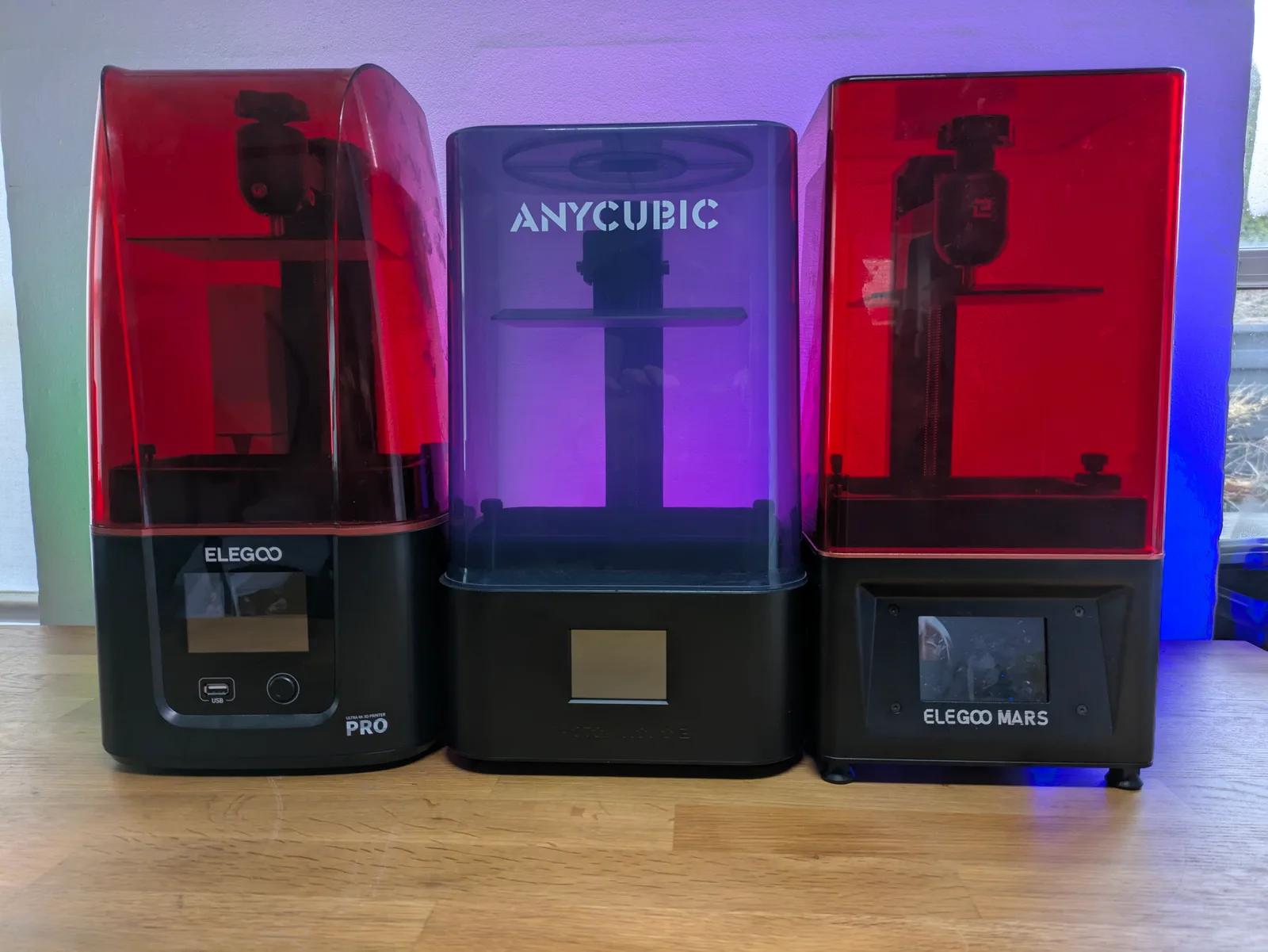
Elegoo and Anycubic both make competent miniature printers in 2026. The internet treats it as a tribal choice, with forum threads devolving into brand loyalty contests that tell you nothing useful. The two brands have made different bets in this generation, and the right pick depends on which bet matches your printing pattern.
This article gives you the brand-level read: the current printer lineup for each, the key ecosystem differences, and a tier-by-tier matchup so you can find your equivalent without sifting through spec sheets.
The two brands in 2026
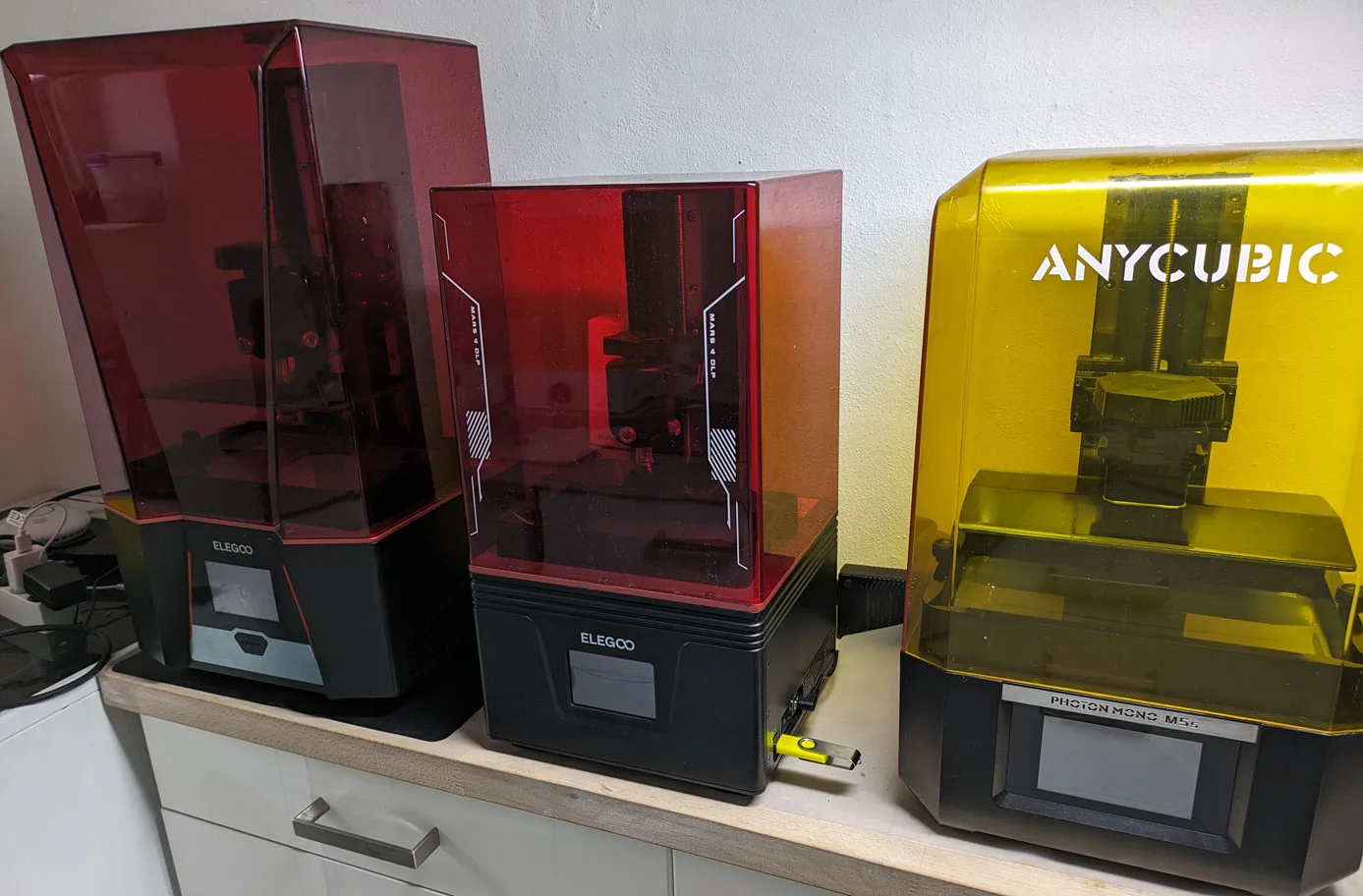
Elegoo is the volume leader in consumer resin printing. The lineup runs across three series: Mars for small-format, Saturn for medium-format, and Jupiter for large-format. The current buying generation covers Gen 4 through Gen 6 depending on price point.
Anycubic is the second-largest brand at roughly the same market position. The Photon Mono naming covers small to medium format; the Photon P1 is the current premium machine and the most interesting in the line.
Neither brand is a niche player. Both have wide community support, broad resin compatibility, and active slicer profile libraries. The decision is not between a good brand and a bad one.
The current printer generation for each brand
Elegoo in 2026
The Mars 4 Ultraaff ($170, 18 micron) is the small-format workhorse. Tempered glass over the screen, ACF release film, anti-aliasing support, and wifi. It prints miniatures very well at a price that is difficult to argue with.
The Mars 5 Ultraaff ($249, 18 micron) sits above it with a tilting VAT for faster prints. Same pixel size as the Mars 4 Ultra, but the tilt mechanism reduces peel force and allows faster lift speeds without sacrificing print quality. Auto levelling is included. If speed matters more than price, this is the small-format upgrade.
The Saturn 3aff ($230, 24 micron) is the entry point for medium-format printing. No smart features, no tilting VAT, just a 24 micron screen on a generous build plate at a fair price. For anyone printing rank and file infantry in batches, it remains one of the best value buys in the Saturn line.
The Saturn 4 Ultraaff ($329, 24 micron) adds the tilting VAT and smart features to the Saturn tier. Anti-aliasing support that the plain Saturn 4 lacks. For the price you get a machine with genuinely faster printing that does not compromise on quality to achieve it.
The Saturn 4 Ultra 16Kaff ($420, 19 micron) is the premium Saturn. 19 micron pixels, heated VAT, tilting VAT, and the sharp-end pixel size that brings it close to the best in class for open-ecosystem consumer machines. One of the few Elegoo machines where the headline specs match the real output.
The Jupiter 2aff ($849, 20 micron) is the large-format option. 302mm wide plate, 20 micron pixels, automated resin feed, and a heated VAT. Units have not widely shipped at the time of writing and no independent reviews exist yet.
Anycubic in 2026
The Photon Mono 4 ($124, 17 micron) is Anycubic back on form after a difficult speed-chasing generation. 17 micron pixels at the sharpest end of any machine at any price, sensible build volume, no unnecessary features. It just prints small figures very well for very little money.
The Photon Mono 4 Ultra ($219, 17 micron) adds wifi, improved light uniformity, and ACF film over the base Mono 4. Same 17 micron pixel size. The value calculation is simple: near the base Mono 4 price, take it; pushed up near $220, the plain Mono 4 is usually the better buy.
The Photon Mono M7 ($300, 24.8 micron) is the weakest option in the current Anycubic line. It carries the same 100 micron default layer approach as earlier speed-chasing machines, without the heated VAT that at least makes the M7 Pro reasonable. At similar prices you can usually find a discounted M7 Pro, which adds the heater. Skip the base M7.
The Photon Mono M7 Proaff ($414, 24.8 micron) has the heated VAT and 24.8 micron pixels. The original MSRP has collapsed now that the M7 Max is the flagship. At the discounted price it is a reasonable mid-tier buy if a heated VAT matters. At anything near full list price, the Saturn 4 Ultra 16K is the better machine.
The Photon P1 ($599, 16.8 micron) is the current Anycubic premium and genuinely different from the rest of the line. Wave Release Technology, a heated VAT, 16.8 micron pixels, and a dual material system. Worth its own section below.
The headline difference: how each brand chased speed
Elegoo solved the speed problem by tilting the VAT. That sentence matters more than any spec comparison. When a layer finishes printing and the build plate lifts, the film underneath has to peel away from the cured resin. On a standard vertical lift printer, that peel force is brutal on fine supports, thin spear tips, and cape edges. Elegoo’s answer was to tilt the VAT slightly during the lift, breaking the seal progressively rather than all at once. The result is a printer that lifts faster, puts less stress on fine detail, and maintains 18 micron pixel quality at speeds the previous generation could not match.
Anycubic took a different approach in the M5 generation and the results were not good. Faster prints were achieved by going to 100 micron default layer heights, thinner FEP film, and resins formulated to flow and cure quickly. The compromise was visible: a noticeably worse print. Anycubic corrected course with the M7 line, and the P1’s Wave Release Technology is a genuinely thoughtful answer to the peel force problem. But the tilt-VAT generation from Elegoo has been in the market for longer and covers more price tiers. Anycubic is a year behind in this specific race.
This matters for miniature painters because fine detail and supported overhangs are exactly where peel force damage shows up. Cape edges, sword tips, weapon hafts, and facial details under a head turn all benefit from reduced peel stress on every single lift cycle across a multi-hour print.
Slicer and ecosystem
Elegoo bundles Chitubox CE on the included USB drive. It is fine. The community has largely moved to Lychee Free or Chitubox proper anyway, and both work with every current Elegoo machine.
Anycubic bundles Photon Workshop, which is competent for basic printing. The community similarly gravitates to Lychee or Chitubox for miniature-specific support settings.
Neither slicer bundle is a reason to pick one brand over the other. Both Lychee and Chitubox have broad tested profile libraries covering machines from either brand.
Resin compatibility
Both brands run open-ecosystem resins with no proprietary lock-in. Anycubic’s house resin is fine; Elegoo’s house resin is fine. Both are outclassed for miniature work by purpose-formulated options like Wargamer Resinaff or AmeraLabs TGM-7aff. The best resin for miniatures guide covers the detail on which resin to actually use.
Reliability and support
Both brands have known failure modes that any experienced resin printer owner should know. LCD screens wear with exposure hours. Build plate clamps occasionally loosen. FEP and ACF film tears with heavy use. None of this is unique to either brand; it is the nature of the technology.
Community support is roughly comparable across Reddit and the major resin printing forums. Customer support from either brand is adequate for warranty claims and not exceptional. There is no clean winner here. Buy from whichever brand has the machine that fits your price tier.
The Photon P1: a genuine outlier
The Photon P1 ($599) deserves its own section because it is genuinely different from everything else in the Anycubic line.
Wave Release Technology is Anycubic’s answer to the same peel force problem Elegoo solved with the tilting VAT, via a different mechanism. The P1 uses a different film and lift profile that breaks the peel progressively, achieving lower peel force on fine supports. Combined with a heated VAT, auto levelling, and 16.8 micron pixels, the P1 is genuinely competitive at the premium tier.
The standout feature no other consumer machine offers is dual material printing. The P1 can mix two resins on the same print, opening possibilities for support resins that wash away cleanly or for two different materials on a single plate. This is a real feature.
The caveat is equally real: the slicer support is unfinished. Photon Workshop alone supports it fully, and Photon Workshop is rough to use for miniature work. Lychee handles the P1 for single-material printing but does not fully support the dual material workflow at the time of writing. Treat the dual material system as an interesting future rather than a finished product you can rely on today.
The relevant comparison is the Saturn 4 Ultra 16K at $420. The Saturn is faster on the tilt mechanism and $179 cheaper. The P1 has the more interesting peel mechanics and the dual material option. If dual material printing matters to you, the P1 is the only machine in this segment that does it. If it does not, the Saturn is the better value.
Tier-by-tier matchups
$120 to $200 small format
The Anycubic Photon Mono 4 ($124) versus the Elegoo Mars 4 Ultra ($170).
The Mono 4 has 17 micron pixels, the sharpest available at any price in this tier. The Mars 4 Ultra has 18 micron pixels with ACF film, tempered glass, and anti-aliasing support. Both print miniatures very well. The pixel difference at 17 versus 18 microns is not visible at 28 to 32mm scale. The Mars 4 Ultra is the better-specified machine; the Mono 4 is the better value at its price. Both are recommended without hesitation.
If you find the Photon Mono 4 Ultra near the base Mono 4 price, the extra light uniformity and ACF film make it the pick. At $219 it is harder to justify over the Mars 4 Ultra.
$230 to $330 mid format
Saturn 3 ($230) or Saturn 4 Ultra ($329) versus Photon Mono 4 Ultra ($219) or Mono M7 Pro ($414).
The Saturn 3 is the value pick at $230: 24 micron pixels, basic feature set, and a big plate. The Saturn 4 Ultra adds the tilting VAT for $329, which is meaningful for anyone printing regularly.
The Anycubic mid-tier is harder to recommend at this range. The Mono M7 Pro has a heated VAT and has dropped to around $414, but the pixel size at 24.8 microns is slightly coarser and the speed approach relies on layer height rather than reduced peel force. At equivalent prices, the Elegoo Saturn 4 Ultra is the stronger mid-format buy.
$400 to $600 premium
Saturn 4 Ultra 16K ($420) versus Photon P1 ($599).
These are different machines built around different priorities. The Saturn 4 Ultra 16K is faster, sharper on square pixels, and cheaper. The Photon P1 has Wave Release Technology, a heated VAT, and the dual material system.
Pick the Saturn 4 Ultra 16K if print quality per dollar is the constraint. Pick the Photon P1 if dual material printing is a workflow you actively want to explore.
Who picks which brand
The Elegoo buyer in 2026 wants the tilt-VAT generation, values speed without compromising on pixel quality, and is either in the small-format Mars tier or the mid-format Saturn tier. The lineup is wide enough to cover every price point from $170 to $420 with a recommended machine.
The Anycubic buyer in 2026 wants either the entry-level value of the Photon Mono 4 at $124, where it genuinely leads the market, or the specific features of the Photon P1 at the premium tier. The middle of the Anycubic range is less compelling than the Elegoo equivalents right now.
The read
Elegoo is the safer default for a first miniature printer in 2026. The tilt-VAT generation is available across more price tiers, the print quality is consistent, and the community support around the Mars and Saturn lines is deep.
Anycubic is the more interesting choice if the Photon P1’s dual material system or Wave Release Technology matters to you, or if the entry-level Photon Mono 4 at $124 fits your budget better than anything in the Elegoo small-format line.
There is no wrong answer when comparing machines at the same price point. Both brands produce miniatures that look identical on the painting table.
For the specific recommended picks across every price tier, see the best 3D printer for miniatures guide. For resin choices, see best resin for miniatures. If you are comparing specific Elegoo machines, the Elegoo Saturn 3 vs Saturn 4 Ultra and Elegoo Mars 4 Ultra vs Mars 5 Ultra comparisons cover those decisions in detail. If you are earlier in the process than brand choice, how to choose the right resin 3D printer is the right starting point.