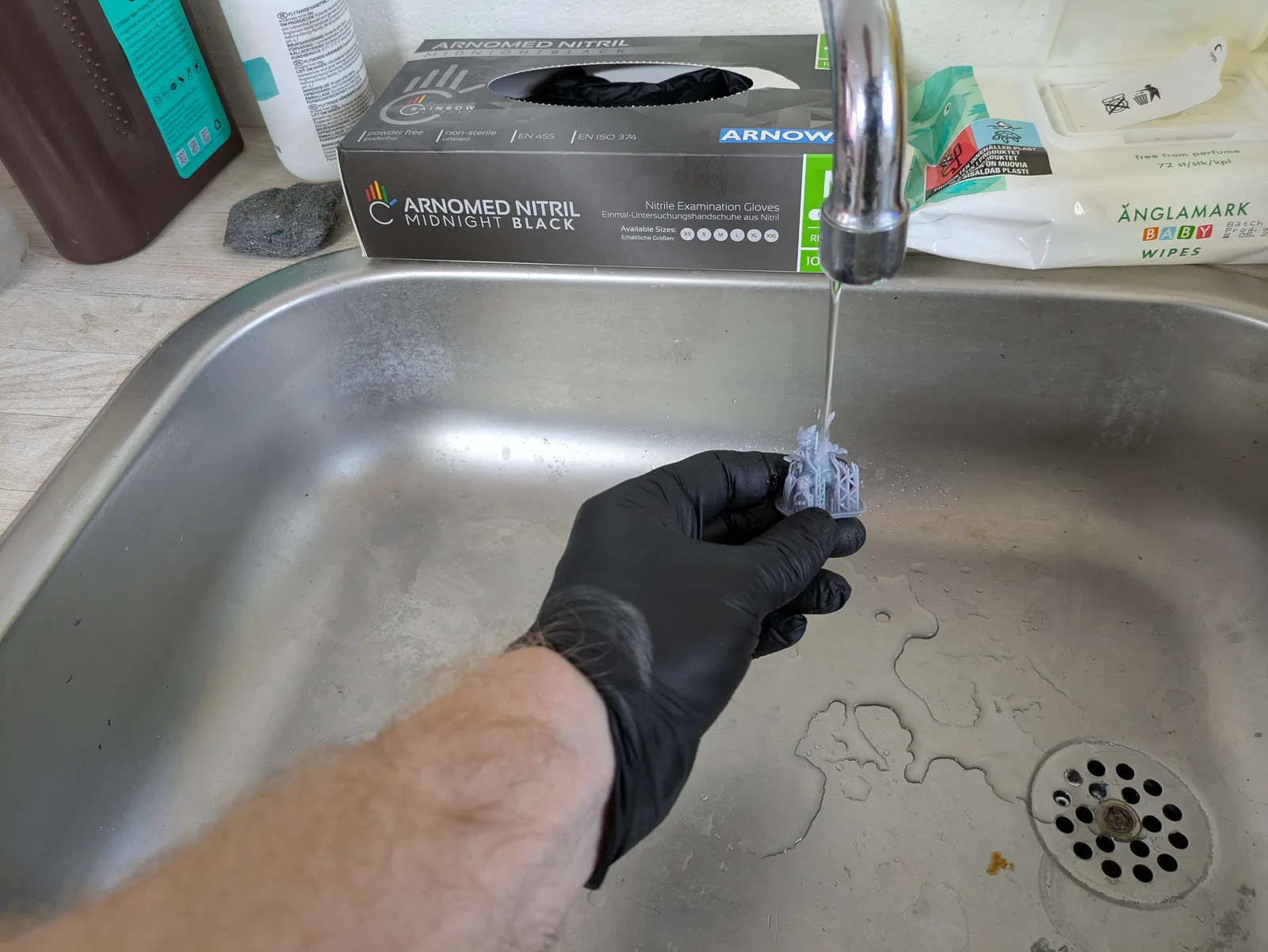
Now you have your miniatures hanging upside down from the build plate and it is time to get them off and clean them with alcohol or something similar. This lesson covers the alcohol cleaning workflow from start to finish: removing models, support removal, the three-container wash method, drying, curing, and what to do with contaminated IPA when it is spent.
Set up before you touch anything
The biggest mistake in post-processing is starting before the workspace is ready. Gloves and mask on. Paper towels within reach. All containers open and in position. Plastic scraper ready. Spare paper towels under the containers in case of drips.
PPE goes on before the build plate leaves the printer. Liquid resin is on those models and it is on the build plate. The moment you carry the build plate to the wash station you are handling live resin. Mask and gloves first, always.
Removing models from the build plate
Hold the build plate at an angle, not flat. Holding it flat means any liquid resin that drips falls straight down. At an angle, drips go to one corner and can be directed. Hold it over the vat if you can while you carry it to the wash station.
At the wash station, position the build plate with the models hanging down over the appropriate container. Take the plastic scraper and work it under the edge of the raft. Gentle, even pressure. Models should come off with modest force. If they are stuck firmly, a heat gun applied briefly to the back of the build plate can help. Do not apply sustained heat. A quick pass is enough to loosen the bond.
Wear safety glasses during model removal. A raft under tension can flex and release unexpectedly, and liquid resin flicking toward your face is one of the more unpleasant things that can happen at the wash station.
Check the build plate after removal
Once the models are off, check the build plate surface for any remaining resin or bits of raft. Wipe it clean with a paper towel. Any dried or partially cured resin left on the build plate will affect the next print. Clean it while the resin is still liquid.
Support removal
Remove supports before washing. Doing it after is possible, but freshly removed supports are easier to break at the connection point when the model has not been washed yet.
Use your hands. Work at the connection point between the support tip and the model. A controlled snap at that point leaves the smallest mark. Using a knife to cut supports introduces the risk of slipping onto the model surface.
For stubborn supports that will not release cleanly, a brief pass with a heat gun softens the resin enough to help. Do not overheat. A few seconds is enough. Overheating cured resin discolours it and softens it so much that the model deforms.
Do not remove supports over a container of clean IPA. Resin residue from the snap point goes into the wash medium and contaminates it faster.
The three container method
Three containers for alcohol washing: one dirty, one less dirty, one for the final wash.
Container one: Dirty IPA. This is your first wash. Submerge the model, agitate it for a minute or two. This removes the bulk of the surface resin. This container will become contaminated quickly. That is its job.
Container two: Less Dirty IPA. Second wash. Cleaner IPA to get the residue that container one did not. Agitate again.
Container three: Wash Station. A powered wash container with a motor that moves the IPA through the models. Ten minutes in the wash station, with the lid on. This is the final clean.
The wash station IPA is the cleanest of the three. When container one gets too dirty to use, dispose of it and promote container two to container one. Fill a new container two with fresh IPA. The wash station IPA rotates into container two when it is no longer clean enough for final washing.
This rotation keeps the wash quality consistent without replacing all of your IPA at once.
Drying before curing
This step is where many beginners make a mistake. Curing a model that still has alcohol on the surface causes white specks on the finished model. The alcohol gets trapped under a cured outer layer and leaves a permanent chalky residue.
Dry the models for 10 to 20 minutes after washing. Leave them in the air. You can use a fan to speed up evaporation. Do not cure until the models are visibly and completely dry. If you are uncertain, wait longer.
Curing
A cure station with a UV light and a rotating turntable is the standard tool. 10 to 15 minutes is appropriate for a standard miniature. The rotating platform ensures even UV exposure on all surfaces.
Some larger or more complex models may need longer, or may need to be repositioned mid-cure to ensure UV reaches all surfaces.
Do not over-cure. Over-cured resin becomes brittle and yellows. 10 to 15 minutes is a starting point; if your models are coming out brittle or discoloured, reduce cure time.
Post-curing behaviour
Models warp slightly during curing. This is normal. Leave models for 24 hours after curing before doing anything structural, such as assembling multi-part models. The resin continues to settle slightly as it finishes curing internally.
If you are assembling multi-part models that need to fit together precisely, a useful approach is to glue the parts together before curing, then cure the assembled model. The parts cure into position and the fit is better than assembling after separate curing.
Workspace cleanup
Do not leave models sitting in IPA for extended periods. A few minutes to hours is fine. Days is not. Prolonged IPA immersion softens cured resin, affecting surface detail and structural integrity.
After the session:
- Pour excess resin in the vat back into the bottle through the filter. Clean the vat.
- Wipe paper towel drips. Any paper towels with liquid resin on them are contaminated waste.
- Small offcuts of supports and failed prints should not go into the regular rubbish while they are uncured. Put them in a clear plastic bag and leave them outside in sunlight. UV from the sun cures the resin. Once cured, the bag goes into normal rubbish.
Disposing of contaminated IPA
When container one reaches the end of its useful life, the IPA has a high concentration of dissolved and suspended uncured resin. This cannot go down the drain.
The disposal method is straightforward. Take the lid off the container. Take it outside. Leave it in an open, safe location in sunlight, away from anything flammable and away from children and pets. The IPA evaporates. The UV from the sun cures the resin residue. After a few hours to a day or two depending on conditions, you are left with a hardened resin slurry at the bottom of the container. This cured residue can go into normal rubbish.
Do not attempt to distil contaminated IPA to recover it. Distilling IPA is a fire hazard, and the result still contains dissolved photopolymers. It is not worth the effort or the risk. The sun does the same job for free.
For the water washable equivalent of this workflow and more on the full post-processing approach, the article How to Post-Process Resin Miniatures for Painting covers both methods side by side.