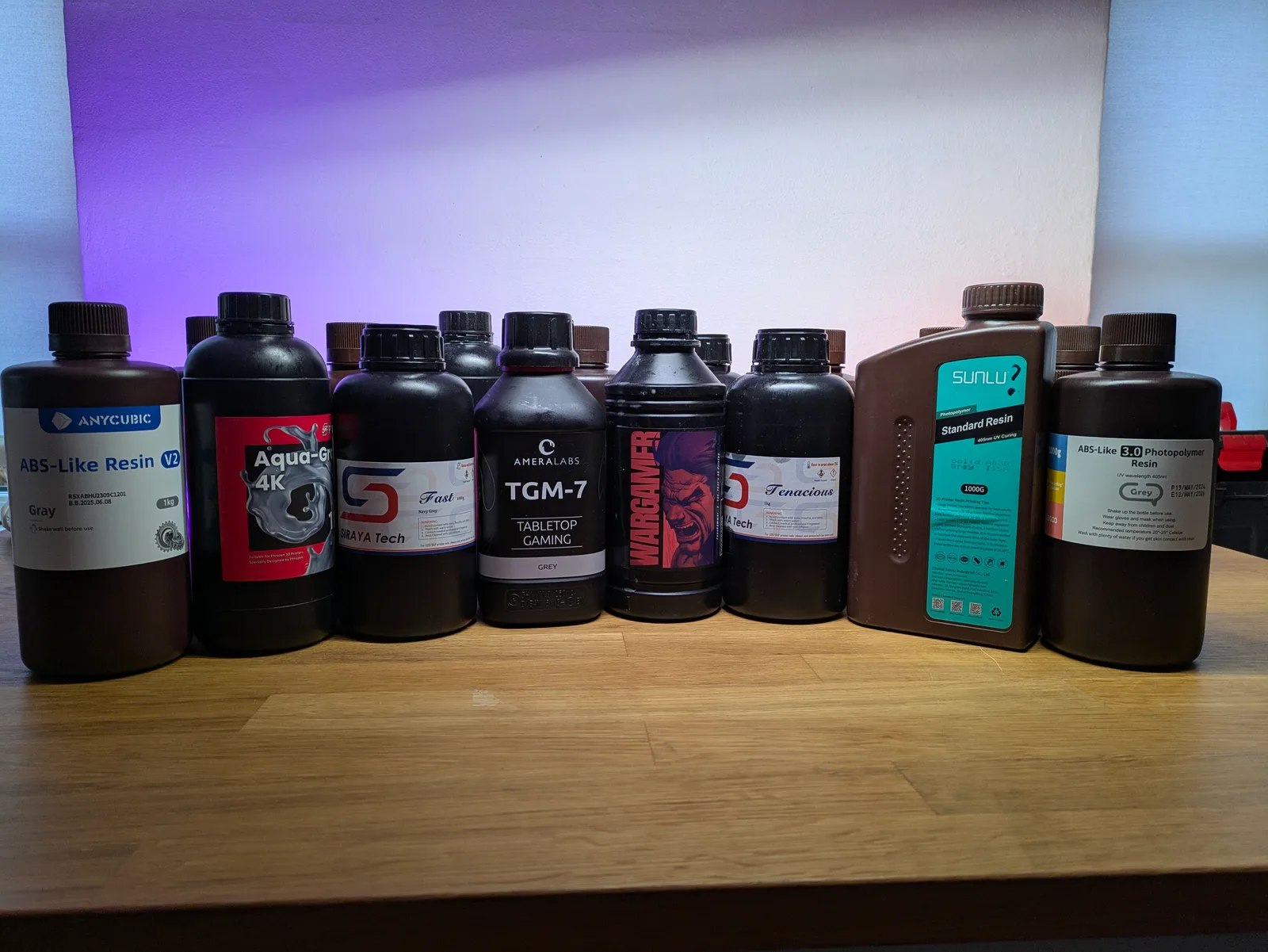
The answer that gets repeated on most forums is twelve months unopened. The label on most bottles says the same. The reality is more useful: most resins last considerably longer than twelve months when stored properly, and considerably less when stored badly.
Understanding what the manufacturer actually means by twelve months, what shortens or extends shelf life, and how to tell whether an old bottle is still good will save you both money and a failed print session.
What the manufacturer means by twelve months
The figure printed on the bottle is not a use-by date. It is the period during which the manufacturer guarantees that the resin will behave within its published exposure-time specification. After twelve months, the resin can still print perfectly well. The manufacturer simply stops guaranteeing that the calibration they shipped is still accurate.
Think of it the way you might think of a freshness guarantee on a packet of flour. The flour is still flour after twelve months in a sealed bag in a cool cupboard. The manufacturer just tested to twelve months and stopped there.
For hobbyist printing, this distinction matters. If you have a bottle that is fourteen months old, stored in a cool dark cupboard, the practical question is not “has it expired?” but “does it still print?” The answer to that question requires a small test, not a disposal.
What actually changes over time
Three things change inside a bottle of resin as it ages, in order of how often they actually cause problems.
Pigment settling. Long-stored bottles separate. The denser pigment particles sink to the bottom and the carrier liquid sits above them. Visually the bottle looks like it has a layer of sludge at the base. This is not degradation; it is physics. The fix is gentle agitation before pouring. Shake the bottle, or roll it slowly between your palms for a minute or two, until the colour is uniform throughout. Do not assume a settled bottle is ruined.
Photoinitiator drift. The chemistry that initiates curing under UV light shifts slowly over time. The resin still cures; the optimal exposure time shifts away from where it was when the bottle was calibrated. A bottle that printed perfectly at 2.5 seconds per layer when new might need 3 seconds or 2 seconds after a year of storage. Running a calibration test before printing from any bottle stored for more than a year will catch this and cost you one small test print rather than a failed batch.
Reactive monomer drift. The base resin chemistry can change subtly with temperature cycling and time. This shows up as slight differences in the flexibility, hardness, or brittleness of cured parts. It is the least common problem at hobbyist storage spans, but it is worth knowing it exists if a bottle that used to print flexible parts now produces brittle ones.
Storage conditions that extend shelf life
Three conditions, in order of importance.
Temperature. Below approximately 20°C is the target. Resin sitting on a windowsill or near a radiator ages faster than resin in a cool cupboard. The cooler the storage, the slower the chemistry shifts. A house cupboard away from heating vents sits at roughly the right range.
Darkness. Direct or indirect daylight starts the cure reaction in the bottle over time. The bottle is usually opaque, which helps, but indirect UV through a window reaches more than most people expect. A closed cupboard, ideally one that does not receive light when opened frequently, is the right answer.
Temperature stability. Consistent temperature matters almost as much as low temperature. A garage that swings between 5°C in winter and 30°C in summer cycles the chemistry through expansion and contraction repeatedly. A house cupboard at a roughly stable 18°C is far better than a garage, even if the garage gets cooler on average.
Storage conditions that shorten shelf life
Sunlight. The single biggest accelerant. A clear bottle left in a sunny window can be effectively ruined in a matter of weeks. The UV does exactly what a UV lamp does in a cure station: it starts curing the resin. The result is a bottle that has partially reacted and will never print correctly.
Heat. A heat source nearby, a car boot in summer, a windowsill during a warm week. Any of these age the resin faster than six months of correct storage.
Repeated temperature swings. This is worse than consistent warmth. Every cycle stresses the chemistry in ways that steady-state storage does not. If you cannot control temperature, prioritise stability over exact numbers.
How to tell whether an old bottle is still good
Three checks, in order. Stop at the first one that gives you a clear answer.
Look. Is there settled pigment? Shake and re-examine. Is there visible cloudiness, chunks, or a gel-like texture that does not shake clear? That is a bottle to discard. Normal resin after agitation is a smooth, uniform liquid with no lumps.
Smell. Pour a small test amount into the VAT. Normal resin has a smell, but it is the standard chemical odour you are used to. A strong solvent smell, an off-vinegar smell, or anything that is noticeably different from the normal scent of that resin is a warning. Trust your nose; it has been trained by every previous session.
Run a calibration test. If the resin looks and smells acceptable, run a RERF test or a Cones of Calibration print at a range of exposure times. If the test produces usable prints at any exposure setting, the bottle is fine. Recalibrate to whatever exposure works now and continue printing. See how to read RERF exposure test results for the full walkthrough, and resin printer calibration tools for the full set of available tests.
The calibration test is the only true answer to “is this resin still good?” A bottle that passes on sight and smell but then fails the calibration test every time across a full exposure range has photoinitiator drift beyond recovery. A bottle that looked slightly suspicious but prints cleanly is fine.
What to do with a bottle that did not survive
Do not pour liquid resin down the drain. The cured solid is safe to handle and dispose of as normal plastic waste; the liquid is not.
Cure it out. Pour the resin into a flat container, something like an old baking tray or a large zip-lock bag spread flat, and put it in direct sunlight for several hours until it is fully solid throughout. If sunlight is not available, a UV cure station on maximum power across multiple cycles will work. Once the material is fully cured through, it can go into normal household waste as a solid plastic item.
The disposal section in the post-processing resin miniatures article covers the full process for IPA and resin waste across a printing session. The same principles apply to a bottle you are retiring.
Buying patterns that work with shelf life
Two practical adjustments worth making if you find yourself regularly reviewing old stock.
Buy resin you will use within six months. Hobbyist print volume is genuinely hard to predict in advance. A bottle purchased during a run of heavy printing sits around once the project finishes. Buying smaller quantities more often is cheaper than discarding partially used or expired stock.
If a sale tempts a bulk buy, store it correctly and use oldest first. A sale price on three bottles of resin is not a saving if one of them never prints well. If you do buy ahead, label each bottle with the purchase date, store in cool dark conditions, and rotate so the oldest bottle gets used first. The shelf life is real and generous when conditions are right. Most people who report resin degrading quickly are storing in a garage, on a shelf near a window, or at inconsistent temperature.
The best resin for miniatures guide covers which resins print best for detail work; if you are deciding what to stock, start there before buying in quantity.
The summary
Most properly stored bottles are still printing fine at two or three years. Most badly stored bottles are degraded at six months. The twelve-month figure on the label is the manufacturer’s calibration guarantee. It is the point at which they stop certifying the published exposure time, not the point at which the resin stops working.
The practical test is always the calibration print, not the date on the bottle. If it prints cleanly, it is fine. If it fails calibration across the full exposure range, cure it out and replace it. There is no point replacing a bottle that still works, and no point printing with a bottle that no longer does.