Some links on this page are affiliate links — marked with aff — and if you buy through them I may earn a small commission at no extra cost to you. Read the full disclosure.
Every forum thread on apartment resin printing ends up in one of two places. Half the replies say do not do it, full stop. The other half say throw a printing tent over the machine, run a hose out the window, and you will be fine. Both takes are wrong by half. Resin printing in an apartment is workable if the printer, the resin, and the ventilation are matched to the space. None of those three factors alone is enough. Stack the right ones together and the apartment stops being the obstacle it sounds like.
This article walks through what each of those three things actually needs.
The actual hazards
The two risks worth understanding before anything else are VOC exposure and skin contact with liquid resin.
During a print, the resin in the vat releases volatile organic compounds into the surrounding air. The smell when you open the lid is the evidence. In a garage or workshop with good airflow those VOCs disperse quickly. In a small apartment room with a closed door they accumulate. The concern is not that a single print session is acutely dangerous. The concern is that VOC concentration builds over hours, and a hobbyist who prints several evenings a week in an unventilated bedroom is breathing a progressively higher background level across the week. Sensitisation risk compounds with cumulative exposure, not from a single dramatic event.
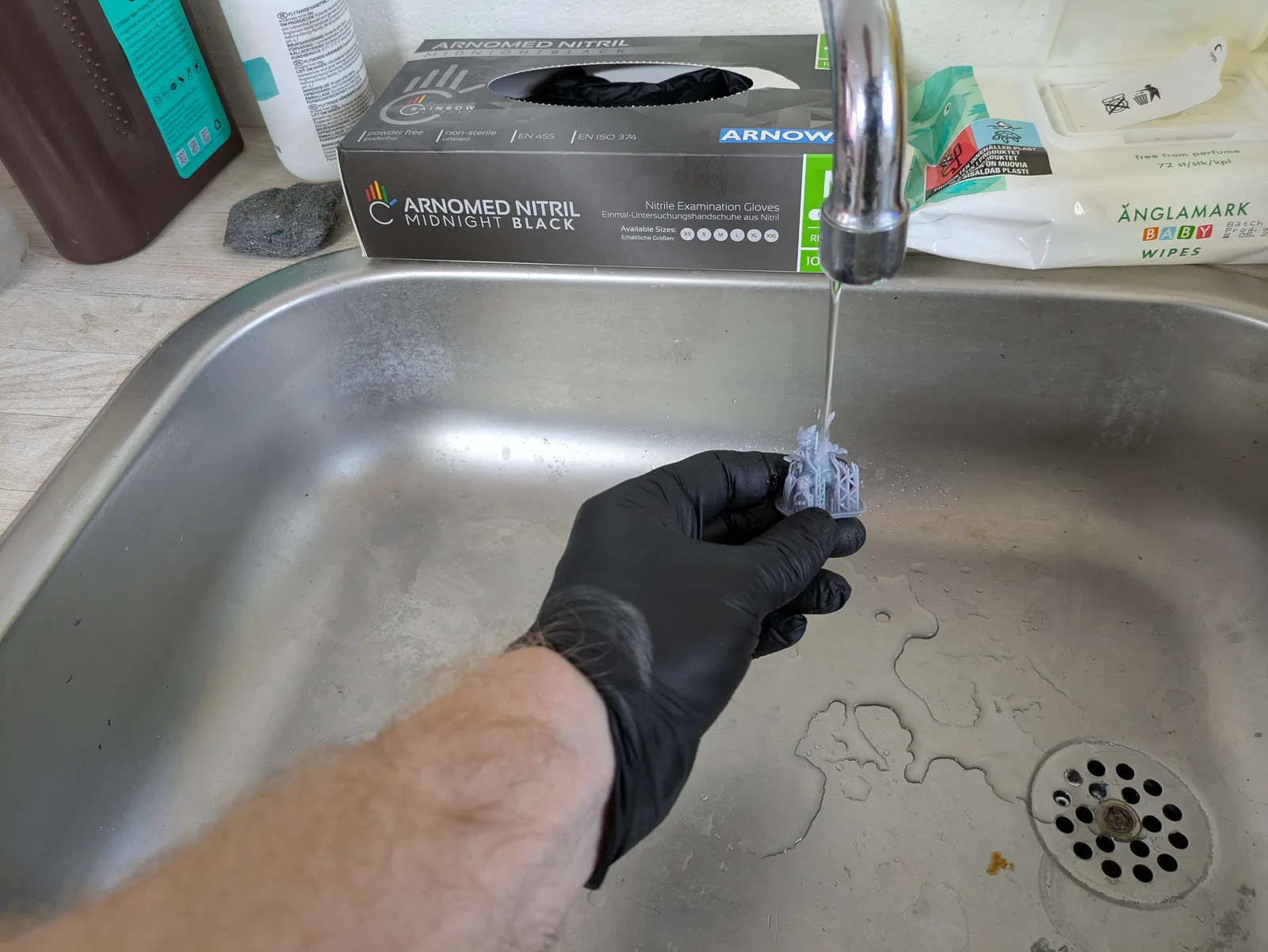
Liquid resin contact with skin is a separate issue. Uncured resin is mildly sensitising, meaning your immune system can gradually learn to treat it as an allergen. Sensitisation typically develops silently over months. You handle resin without symptoms for a year and then one day contact causes a rash. Once sensitised, the reaction does not go away. This is the single most important reason to wear nitrile gloves every time you handle liquid resin, regardless of where you print.
The apartment-specific concern is the VOC accumulation in a small enclosed space. Cured resin, meaning fully UV-exposed and washed, is essentially inert hard plastic and safe to handle bare handed. The safety conversation is almost entirely about the print and wash stages.
Printer features that matter in a small space
Built-in air filtration is the single most useful printer feature for apartment printing. A printer with a built-in filter does not eliminate VOCs, but it meaningfully reduces the concentration spike during a print by running the air inside the enclosure through activated carbon before it reaches the room. The difference between a filtered printer and an unfiltered one is noticeable in a closed room.
The Elegoo Mars 4aff ($149) has a built-in air filter. For most apartment hobbyists this is the sensible starting point. It is a compact machine with 18 micron pixels, no speed tricks, and a small footprint. The value at that price point is difficult to argue with, and the filter is genuinely present rather than decorative.
The Elegoo Mars 4 Ultraaff ($170) shares the same pixel size and adds tempered glass screen protection and wifi. The filter is there too. The Ultra is worth the premium if you want the screen protection; the wifi is less important since you are standing next to the machine anyway.
The Elegoo Saturn 3aff ($230) has a built-in air filter and offers a much larger build plate for print batches. It is a practical choice if you need to print groups of infantry or terrain rather than single figures. The larger footprint is the trade-off in a tight apartment space.
The Phrozen Sonic Mighty 16Kaff ($720) has a built-in air purifier and a heated chamber. It is a serious precision machine with 14 micron pixels and mechanical build quality that holds up over years. It is not a beginner machine and the price reflects that. If you already understand calibration and want the best print quality available in this category, the filtered enclosure is a genuine benefit in an apartment.
The Elegoo Mars 5 Ultraaff ($249) is worth mentioning because it is the upgraded model above the Mars 4 and a popular recommendation, but it does not have a built-in air filter. That is a meaningful gap in an apartment context. Fast printing without filtration still fills the room.
The window-fan rig
A printer with a built-in filter is better than one without, but the filter is not a substitute for real ventilation. The goal is to move VOC-laden air out of the room and replace it with fresh air from outside.
The cheapest effective setup is a bathroom extractor fan or a small box fan set to extract air outward, positioned in or near the window of the room where you print. The printer sits within about a metre of the intake. While the printer runs, open a second window or leave the door slightly ajar elsewhere in the apartment so replacement air can enter from the other side. This creates a gentle airflow through the room rather than the fan just recirculating the same air.
This setup costs around $30 for a basic window fan if you do not have one already. It is not elegant. It works.
For the full argument on ventilation options and how they compare, the companion article Home Resin Printing Safety and Ventilation covers every approach from an open window to a dedicated filtered cabinet, with notes on where each falls short.
Resin choice for a small space
Some resins are marketed as low-VOC and have a noticeably less aggressive smell than standard resin. The Sunlu Plant-Based resin, Anycubic Eco Resin, and Phrozen Aqua-Gray series are labelled low-VOC. They are not unscented. They do still produce vapours. But the difference compared to standard resin is real and worth considering if you are printing in a small space with limited ventilation.
“Low-VOC” is a marketing label, not a regulated chemical classification. Do not treat it as permission to skip ventilation. Treat it as a sensible secondary measure on top of filtration and airflow, not instead of them.
For more on resin options and which perform well at different price points, the best resin for miniatures guide covers the category with current pricing.
Water washable resin: the apartment-friendly choice
Water washable resin removes isopropyl alcohol from the workflow entirely. No IPA means no flammable solvent to buy, store, and dispose of in a building where communal areas and neighbours are close by. In an apartment that is a meaningful practical advantage that goes beyond the smell.
The mechanical strength of water washable resin is lower than a good ABS-Like. For miniatures that are going to be handled, dropped, or played with regularly, that is a real consideration. For display pieces and infantry figures that live on a shelf once painted, it is often not a problem in practice.
Water washable resin has changed significantly in the last couple of years. The full picture on what the current generation can and cannot do is in the water washable resin article.
Where to put the printer
Three locations that work well in a typical apartment:
A covered balcony is the best option if you have one. The printer is outside the living space. VOCs vent naturally. Weather protection is the only practical concern.
A spare room with a window is the next best option. Close the door during prints and while the print is sitting in the vat. Use the window-fan rig described above. The room stays contained and the rest of the apartment stays clear.
A kitchen with an extractor hood above a hob is a usable option. The extractor hood is already ducted outside. The printer placed on the counter near the hob gets meaningful exhaust coverage during a print. Cleanup requires care around food surfaces.
Three locations that do not work well:
The bedroom is the wrong place to put a printer. You sleep there. Residual VOCs from an evening print are still in the air several hours later. Even with ventilation, the cumulative exposure across hundreds of nights is the concern.
The living room without dedicated window ventilation is a poor choice. You spend most of your time there. The room typically has soft furnishings and lower airflow than a kitchen or utility room.
The bathroom, despite having an extractor fan, is a problem for chemistry reasons. High humidity disrupts resin curing and can cause layer delamination and failed prints. Keep resin away from steam and condensation.
The wash-and-cure question
Open-bath IPA washing produces a meaningful amount of alcohol fumes that spread through the room. A dedicated wash and cure station with a sealed lid contains those fumes much better. The alcohol circulates inside the unit rather than evaporating freely into the room air.
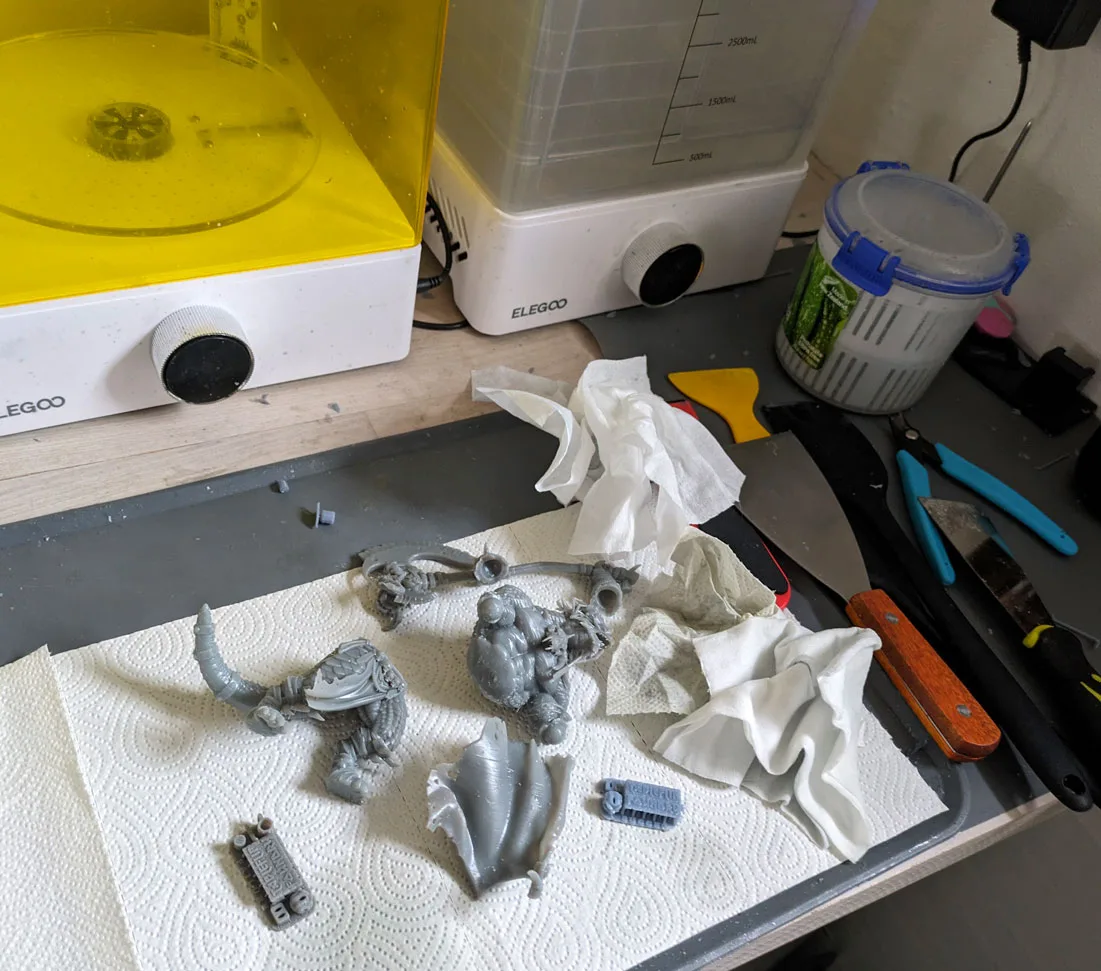
Two stations that work well in this respect are the Anycubic Wash and Cure 3.0 and the Elegoo Mercury Plusaff. Both use a sealed chamber, both do the wash and cure in a single compact unit, and both leave less residual smell in the room than an open tub of IPA.
If you are using water washable resin, the wash station question simplifies considerably. A tub of water, a squirt bottle, and a small UV lamp cover the entire process without IPA fumes at all.
What to do when the lease says something
Some tenancy agreements restrict hobbyist machinery. Some restrict open chemicals. Some are silent on the subject. Read the lease before setting up. If it is ambiguous, ask the landlord directly. Many landlords have no objection to a compact desktop printer used safely; the question is whether yours does.
This is not legal advice. The decision about what your lease permits is between you, your landlord, and the document.
Disposal in a small space
Spent IPA and liquid resin are both hazardous waste. They cannot go into communal apartment bins or down the sink. The apartment-specific problem is that most apartment buildings do not have a shed or garage where you can store waste containers while they build up to disposal size.
The practical answer is airtight containers: one for used IPA, one for partially used or expired resin. Keep them in a cool dark place, away from heat sources. When they are full, take them to a hazardous-waste depot or a hardware store that accepts solvent recycling. Most large hardware chains do.
For the broader post-processing workflow, post-processing resin miniatures covers the full cleanup process including the disposal steps.
The verdict
Resin printing in an apartment is safe enough if you meet at least two of these four conditions: the printer has a built-in air filter; the resin is labelled low-VOC or water washable; washing uses a sealed station; at least one window is open for airflow during print and cure. Stack two of those four and you are in reasonable shape. Stack three or four and you have a workable hobby space.
No combination guarantees zero exposure. That is not what the goal is. The goal is keeping exposure low enough that the hobby is sustainable over years without running into sensitisation or respiratory problems. A ventilated apartment with the right printer and resin gets you there.
Quick-reference kit list
Printer: Elegoo Mars 4 ($149) for a compact setup with an air filter; Elegoo Saturn 3 ($230) if you need the bigger build plate and still want the filter.
Resin: Sunlu Plant-Based or similar labelled low-VOC resin for standard printing; a quality water washable resin if you want to remove IPA from the workflow entirely.
Wash and cure: Anycubic Wash and Cure 3.0 or Elegoo Mercury Plus for a sealed-lid wash that contains alcohol fumes.
Ventilation: a window fan set to extract, positioned near the printer, running during every print session.
Storage: one airtight opaque container per resin bottle in use; one sealed container for spent IPA waiting for disposal.
The full starting-point guide for anyone who has not printed resin before is how to start resin printing miniatures. The printer-specific buying decisions sit in the best 3D printer for miniatures guide.